
1️⃣ Researched, compared and ranked
Best Prop Firms for Beginners in 2026
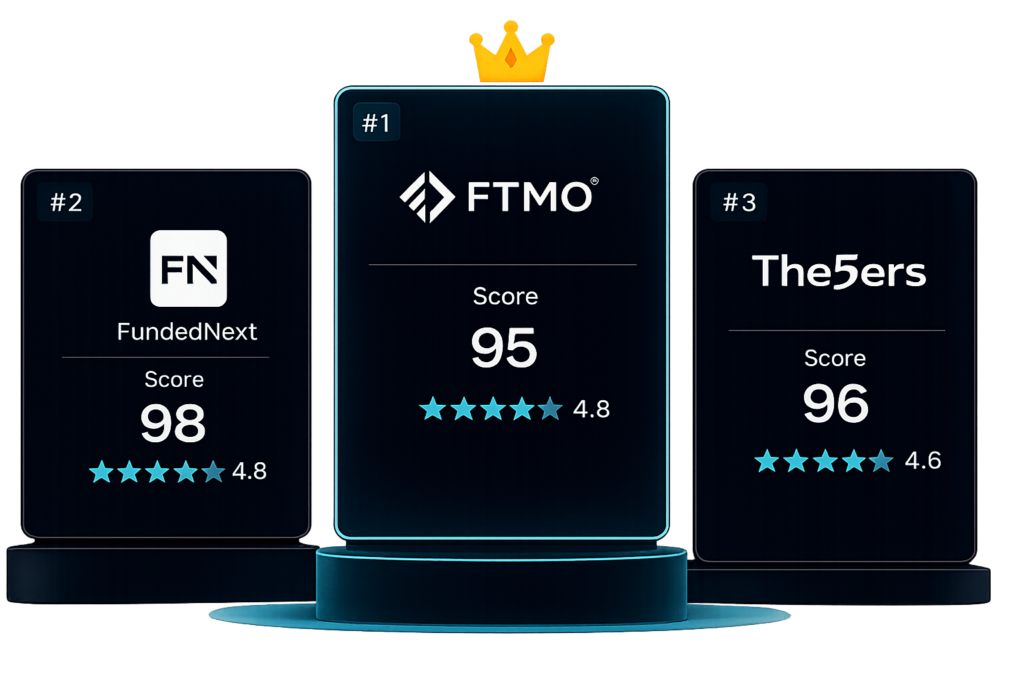
The best prop firms for beginners in 2026 are FTMO, FundedNext, The5ers, Blue Guardian and Alpha Capital. FundedNext ranks first because it combines unlimited free trials, structured educational resources and a clearly documented two-step evaluation. FundedNext is the strongest lower-cost alternative, while The5ers suits patient forex traders who do not want a time limit. Blue Guardian offers an accessible three-step route, and Alpha Capital is the best UK-focused option in this shortlist.
Affiliate disclosure: This page contains affiliate links. We may receive a commission if you purchase through one of these links, at no additional cost to you. Our rankings are based on suitability and published rules rather than the commission offered by a firm.


Christian Preciado
Founder & Lead Researcher at PropFirmsCompare
Christian is the co‑founder and lead researcher at PropFirmsCompare, specialising in prop firm evaluations, trading rules, and payout reliability. With hands‑on experience at Glencore in institutional commodity trading, he brings real‑market insight to every review. He has personally tested dozens of prop firms, focusing on transparency, trader‑first policies, and long‑term funding success
View full bio →
Last verified: 12 September 2026
Methodology: How we compare and score prop firms
Top 5 Prop Firms for Beginners

FTMO

FundedNext

The5ers

Blue Guardian

Alpha Capital
Beginner-friendly does not mean easy to pass. Higher Overall Score doesn not mean is better for beginners. Every prop-firm evaluation has rules that can end an account, and purchasing a challenge before you have a tested strategy can turn a relatively small fee into repeated losses.
Best prop firms for beginners: quick comparison
| Rank | Prop firm | Best for | Recommended beginner route | Main advantage | Main limitation |
|---|---|---|---|---|---|
| 1 | FTMO | Learning the evaluation process | Two-Step Challenge | Unlimited free trials, Academy and clearly documented rules | The 10% first-phase target still requires patience |
| 2 | FundedNext | Lower-cost entry and programme choice | Stellar Lite or Stellar Two-Step | Free trial, no time limit and lower-target two-step routes | Several programmes can make selection confusing |
| 3 | The5ers | Patient forex traders | High Stakes | Unlimited evaluation time and static 10% maximum loss | Three profitable days and news-execution restrictions |
| 4 | Blue Guardian | Lower-pressure progression | Three-Step Challenge | Marketed as its most accessible, lower-cost route | Rules vary significantly across programmes |
| 5 | Alpha Capital | UK-focused traders | Standard two-step evaluation | Unlimited time, 8% and 5% targets and UK presence | Lower maximum advertised performance split than some rivals |
Use the prop firm comparison tool to compare the firms side by side. Do not select an account purely because it displays the largest balance or highest profit split.
How we ranked beginner-friendly prop firms
Our wider scoring methodology considers drawdown, payouts, trading conditions, evaluation fairness, cost, technology and transparency. For this page, we placed additional emphasis on the issues most likely to affect a first-time challenge buyer:

100% Independent & Unbiased Rankings
We test, compare and rank prop firms based on real data and actual trader experiences.
- whether the firm provides a free trial or realistic practice environment;
- how clearly daily and maximum loss are calculated;
- whether the maximum loss is static or trailing;
- whether the evaluation has a time limit;
- the number and size of the profit targets;
- minimum-day, consistency or best-day requirements;
- availability of smaller, lower-cost account sizes;
- educational resources and support;
- the complexity of choosing between programmes; and
- the consequences of making a withdrawal.
We did not award a higher rank simply because a firm advertises a 90% or 100% performance split. A beginner has to pass, preserve the account and become eligible for a reward before the headline split becomes relevant.
All the firms on this page provide simulated evaluation or funded-stage accounts. The displayed account balance should not be interpreted as cash deposited in the trader’s name.
1. FTMO — best overall prop firm for beginners

FTMO is our best overall choice because it provides a structured way to learn the challenge process before paying. Traders can take as many free trials as they need, and FTMO explicitly recommends beginning with its free trial. It also operates FTMO Academy, which includes beginner and intermediate material as well as a trading psychology course.
For a beginner, we recommend considering the FTMO Two-Step Challenge rather than automatically choosing the faster one-step route.
The two-step evaluation uses a 10% target in the Challenge and a 5% target in Verification. It has a 5% maximum daily loss, a static 10% maximum loss, four minimum trading days in each evaluation phase and no overall time limit. A static maximum loss is generally easier for a new trader to monitor than a loss threshold that follows the account’s highest balance.
FTMO’s one-step programme removes the Verification phase, but it uses a 3% maximum daily loss, an end-of-day trailing maximum-loss calculation and a best-day rule. A quicker route is therefore not automatically a simpler route.
Why FTMO suits beginners
- Unlimited free trials allow you to test your process before paying.
- The two-step rules and calculations are documented in detail.
- The maximum evaluation period is unlimited.
- The Academy provides structured educational material.
- Traders can begin with a smaller account instead of paying for the largest option.
- FTMO has operated since 2015 and supports several established trading platforms.
What to consider
The 10% first target can encourage impatient traders to increase position size. The daily-loss calculation also includes open positions, commissions and swaps, so merely keeping closed losses below 5% is not enough.
FTMO is best for a beginner prepared to complete several free trials under the exact risk rules they intend to use in the paid evaluation.
Read our full FTMO review or compare FTMO versus The5ers.
2. FundedNext — best lower-cost two-step option

FundedNext is the strongest commercial alternative for beginners who want a free trial, unlimited evaluation time and a choice between lower-target two-step models.
Its Stellar Two-Step programme requires an 8% target followed by 5%. Stellar Lite lowers the second target to 4% and is positioned as the lower-upfront-cost route. FundedNext also offers a free trial for its CFD programmes and states that those challenges have no time limit.
For most new traders, Stellar Lite or Stellar Two-Step is a more appropriate starting point than Stellar Instant. Instant access removes the evaluation target, but it does not remove drawdown, reward eligibility or behavioural restrictions. Paying more to skip the challenge is rarely useful when a trader has not yet demonstrated consistency under prop-firm rules.
Why FundedNext suits beginners
- The 8% first-phase target is lower than the 10% used by several traditional challenges.
- Stellar Lite provides a lower-cost way to learn the process.
- A free trial is available.
- There is no maximum evaluation time on the CFD challenges.
- Several platforms and programme structures are available.
- Traders can compare one-step and two-step routes without changing provider.
What to consider
The number of products can be confusing. Programme names that sound similar may use different targets, drawdown limits, reward schedules, fee-refund conditions and add-ons.
Do not simply choose whichever route shows the quickest first reward or highest percentage. Open the rules for the exact programme and record its daily loss, total loss, minimum days, reward eligibility and prohibited strategies before checkout.
FundedNext is best for a beginner who has completed the free trial and wants a smaller two-step evaluation with a lower initial cost.
Read our FundedNext review or see the detailed FTMO versus FundedNext comparison.
3. The5ers — best for patient forex beginners
The5ers High Stakes programme is a strong option for forex beginners who are willing to progress slowly and trade within a conventional two-step structure.
The evaluation has a 10% target in step one and 5% in step two, a 5% maximum daily loss, a static 10% maximum loss and an unlimited maximum trading period. Traders need three profitable days in each phase, with a profitable day defined according to the firm’s published threshold.
The absence of a deadline is important. A beginner who needs to achieve a target within 30 days may force trades when the market does not provide a valid setup. Unlimited time makes it possible to reduce frequency and wait for the strategy’s normal opportunities.
The5ers permits overnight and weekend holding on High Stakes. Positions may remain open through news, although executing orders in the two minutes before or after specified high-impact news is restricted. The programme currently uses MT5.
Why The5ers suits beginners
- No maximum evaluation period.
- Static rather than trailing maximum loss.
- Conventional 10% and 5% two-step targets.
- Smaller entry account sizes are available.
- Overnight and weekend holding can suit slower strategies.
- The programme encourages gradual progression rather than a single aggressive push.
What to consider
The profitable-day condition means that opening a token trade on three days may not satisfy the requirement. Traders must understand exactly how a qualifying day is calculated.
The5ers is also more forex-focused than some multi-market competitors. A trader primarily interested in futures or a wide selection of platforms may prefer another provider.
This is best for someone already trading a repeatable forex strategy who wants unlimited time and does not need extensive platform choice.
Read our complete The5ers review.
4. Blue Guardian — best lower-pressure three-step alternative

Blue Guardian offers instant, one-step, two-step and three-step CFD programmes. Its three-step challenge is specifically presented as its most accessible, lower-cost and lower-pressure route for traders who are just getting started.
A three-step evaluation may initially sound harder because it requires more phases. In practice, an additional phase can be preferable when each target is smaller and the account provides enough room to trade normally. The relevant comparison is not simply one step versus three steps; it is the combined relationship between targets, drawdown and cost.
Why Blue Guardian suits beginners
- Several progression routes are available.
- The three-step product is designed around lower entry pressure.
- Smaller account sizes are available.
- The firm offers routes for both CFD and futures traders.
- Blue Guardian has shown repeat conversion activity in your existing affiliate data.
- There is a dedicated Blue Guardian review on the website.
What to consider
Blue Guardian’s large number of products also creates complexity. Its instant, one-step, two-step and three-step accounts should not be combined in one generic set of statistics.
Some programmes use trailing drawdown or different payout conditions. A beginner must select the precise plan first and then evaluate that plan’s rules. Do not rely on a general Blue Guardian score, advertised maximum allocation or maximum split.
Blue Guardian is most suitable for a cost-conscious trader who prefers smaller targets across more phases and is prepared to study the exact programme documentation.
5. Alpha Capital — best UK-focused option

Alpha Capital is the best option in this ranking for traders who prefer a UK-focused company and a conventional two-step progression.
Its standard pathway uses an 8% virtual profit target in phase one and 5% in phase two, with no time limit. After completing the assessment, eligible traders can receive an 80% performance fee on the simulated analyst account. Alpha Capital currently advertises account sizes up to $200,000, unlimited trading days and one-to-one risk reviews.
The lower first-phase target can make the required return feel more manageable than a traditional 10% challenge. However, target size must still be considered alongside the daily and maximum loss method of the selected product.
Why Alpha Capital suits beginners
- Straightforward 8% and 5% two-step progression.
- No evaluation deadline.
- UK-focused company and support proposition.
- One-to-one risk reviews are advertised.
- The standard performance split is easy to understand.
- Several account sizes are available.
What to consider
Alpha Capital offers multiple products, including models with different drawdown methods. Do not assume every Alpha Capital account uses the same rules as its standard two-step assessment.
A UK address also does not mean that a retail prop evaluation is equivalent to an FCA-regulated brokerage account. The accounts and performance fees described by the firm are based on simulated trading.
Alpha Capital is best for a UK trader who values local positioning, unlimited time and conventional targets more than the industry’s highest advertised reward split.
Read our Alpha Capital review or compare FTMO versus Alpha Capital.
What makes a prop firm beginner-friendly?
A beginner-friendly prop firm does not remove risk. It makes the evaluation understandable enough for a trader to plan that risk before purchasing.
Clear loss calculations
The daily and maximum-loss rules should explain whether the limit is based on balance or equity, when it resets and whether it moves after profit. Static maximum loss is usually easier to monitor than trailing drawdown, although the complete rule set still matters.
No unnecessary deadline
Unlimited evaluation time allows traders to wait for valid setups. It does not make the challenge easier mathematically, but it removes the pressure to manufacture trades before a deadline.
A realistic practice option
A free trial is valuable only when the trader treats it like the paid account. Use the same position sizing, permitted instruments, trading hours and stop-loss process.
Smaller starting accounts
The largest displayed account is rarely the best first purchase. The percentage targets and loss limits normally remain similar across sizes, while the fee becomes more expensive.
Start with the smallest account that allows you to test the full process without treating the outcome as insignificant.
Limited rule complexity
A single clearly documented two-step programme can be more suitable than a firm offering ten different customisations. Every optional add-on creates another condition that must be checked.
Educational support
Education cannot turn an untested strategy into a profitable one, but structured material can help beginners understand drawdown, psychology, position sizing and evaluation mechanics.
New traders should read what a prop firm is and how to pass a prop firm challenge before buying an evaluation.
Which prop firm has the easiest challenge?
There is no objectively easiest prop-firm challenge.
A lower profit target may come with a smaller daily-loss limit, trailing drawdown, a consistency rule or a higher fee. A one-step challenge may remove the second target but apply tighter funded-stage restrictions. A three-step challenge may take longer while allowing smaller targets at each stage.
Compare the following as one system:
- The profit required in every phase.
- The daily loss in cash.
- The total usable loss buffer.
- Whether the total loss is static or trailing.
- Minimum profitable or trading days.
- Best-day or consistency requirements.
- The effect of open positions at the daily reset.
- Whether withdrawals reduce the remaining buffer.
- News, weekend and overnight restrictions.
- The realistic cost of repeat attempts.
The challenge most likely to suit you is the one whose rules allow your existing strategy to operate normally. It is not necessarily the challenge with the smallest target.
How to choose your first prop-firm account
Complete a meaningful sample first
Do not buy a challenge after five profitable demo trades. You need enough trades to estimate your win rate, average reward-to-risk ratio, maximum losing streak and normal drawdown.
Use the prop firm probability calculator to test how those variables interact with a challenge target and maximum loss.
Convert every percentage into cash
A 5% daily-loss limit on a $10,000 account is $500. Calculate how many normal losses would use that allowance. Then repeat the calculation for total drawdown.
The drawdown calculator and position size calculator can help.
Start with the programme, not the firm
Decide whether you need static drawdown, unlimited time, weekend holding or a particular platform. Then identify the programme matching those requirements.
Do not select FundedNext, Blue Guardian or Alpha Capital generically. Select a specific programme and compare its exact rules.
Ignore the headline balance
A $100,000 simulated account with a 10% maximum loss gives the trader a $10,000 breach buffer, not $100,000 of freely riskable capital. Your position size should be based on the loss rules rather than the headline account size.
Check your location
Availability varies by country. Use our dedicated rankings for UK traders and US traders when location restrictions affect the shortlist.
A beginner risk framework
There is no universally correct risk percentage for a prop challenge. A sensible figure depends on the strategy’s historical losing streak, correlated exposure and the firm’s drawdown calculation.
A practical process is:
- Write down the maximum daily and total loss in cash.
- Reserve part of the total limit as a safety buffer.
- Identify the longest losing streak in your tested sample.
- Assume a worse streak can occur in future.
- Divide usable risk across that losing sequence.
- Reduce exposure when positions are correlated.
- Include spreads, commissions, swaps and slippage.
- Stop trading before reaching the firm’s hard limit.
- Recalculate the buffer after a withdrawal or rule reset.
- Record every trade in a forex trading journal.
For example, risking 1% per trade on an account with 10% total drawdown allows fewer than ten full losses once transaction costs and open-position fluctuations are included. That may be far too aggressive for a strategy capable of producing a long losing streak.
Read our guide to trading losing streaks and the analysis of why most funded traders fail before setting risk.
Are you still not sure if you can pass a prop firm challenge?
Calculate Your Challenge-Passing Probability
Find out what is your probability of passing an evaluation challenge with our Monte Carlo Probability Calculator.
Should beginners use instant funding?
Instant funding removes the need to reach an evaluation target before entering a funded-stage account. It does not remove the need for a tested strategy.
These accounts often have tighter loss buffers, trailing drawdown, payout thresholds, consistency conditions or a higher initial price. A beginner can therefore reach the account faster while losing it more easily.
Instant funding is more appropriate when you already know:
- your expected drawdown;
- your normal losing streak;
- your average holding time;
- how withdrawals change the loss limit;
- whether your strategy satisfies the consistency rule; and
- how much you can afford to lose in fees.
True beginners should generally start with a free trial or lower-cost evaluation. Experienced traders considering direct access can use our instant funding prop firm comparison.
Common beginner mistakes
The most common mistakes are attempting to pass too quickly, increasing size after a loss, opening correlated trades, misunderstanding the daily reset, changing strategy during the evaluation and purchasing another account without reviewing the previous failure.
A challenge should be treated as a risk-management test, not a race towards the advertised account balance.
Final verdict
FTMO is our best overall prop firm for beginners because its unlimited free trials, Academy and clearly documented two-step rules provide the strongest environment for learning the process.
FundedNext is the best lower-cost alternative, The5ers suits patient forex traders, Blue Guardian provides an accessible three-step option, and Alpha Capital is the strongest UK-focused choice.
Before purchasing, complete a free trial where available, choose a small account and compare the precise programme rules, not just the firm’s headline offer.
Best Prop Firms for Beginners FAQs
FTMO is our best overall choice because it offers unlimited free trials, educational resources and a documented two-step evaluation with no time limit. FundedNext is a strong alternative for traders prioritising a lower-cost two-step route.
There is no universally easiest challenge. Lower targets can be offset by tighter drawdown, trailing loss limits or consistency rules. Compare the complete relationship between target, loss buffer and trading restrictions.
FTMO offers unlimited free trials, while FundedNext advertises a free trial for its CFD programmes. A free trial should be completed under the same risk rules you plan to use on the paid account.
A two-step challenge can be more suitable when it provides a larger or static drawdown buffer. A one-step route is faster, but it may use tighter daily loss, trailing drawdown or a best-day requirement.
Choose the smallest account that allows you to take the process seriously. Larger simulated balances do not necessarily provide more favourable percentage rules and expose you to a higher purchase fee.
There is no standard percentage. Base risk on the strategy’s tested losing streak and the account’s usable drawdown. Leave room for commissions, spread, slippage and correlated positions.
Usually not for a true beginner. Instant accounts can have tighter drawdown and more complex payout requirements. They are more appropriate for traders who already understand their strategy’s statistical behaviour.
Many retail prop firms use simulated evaluation and funded-stage accounts. Eligible traders may receive contractual performance rewards, but the displayed account balance should not be treated as cash deposited in the trader’s name.