

Prop Firm Pros and Cons: Is Funded Trading Right for You?
Trading with a prop firm can give you access to a larger account programme without depositing the equivalent amount of personal trading capital. However, that opportunity comes with evaluation fees, strict drawdown limits, profit-sharing arrangements and rules that may not suit every strategy.
This guide explains the main prop firm pros and cons, how funded trading compares with using your own brokerage account and what to check before paying for a challenge.
The bottom line: a prop firm can be useful for a trader who already has a tested strategy and can follow strict risk rules. It is less suitable for someone who is still learning, needs guaranteed income or regularly changes risk after losses.
On this page
- Prop firm pros and cons at a glance
- What trading with a prop firm means
- Advantages of prop firm trading
- Disadvantages of prop firm trading
- Worked account example
- Prop firm versus personal account
- Who prop trading may suit
- Is prop trading worth it?
- How to choose a suitable firm
- Frequently asked questions
Prop Firm Pros and Cons at a Glance
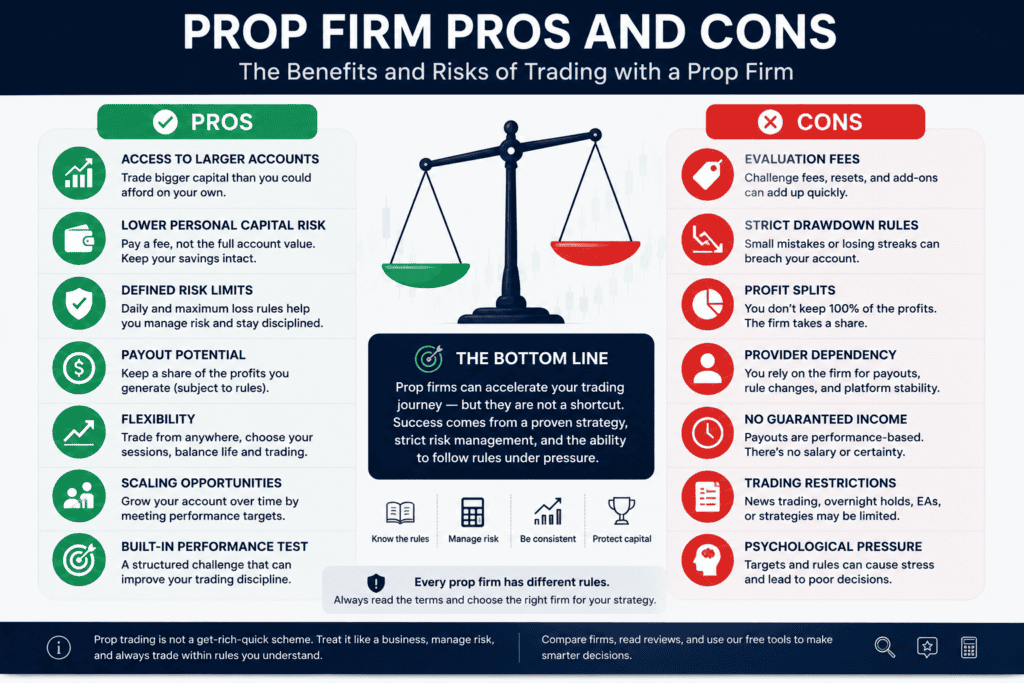
Main advantages
- Access to a larger notional trading account
- Less personal capital required than funding an equivalent account yourself
- Defined daily and maximum loss limits
- Potential performance-based payouts
- Remote access and flexible trading sessions
- Possible account scaling
- A structured test of risk management and discipline
Main disadvantages
- Evaluation, activation or subscription fees
- Strict drawdown and trading rules
- No guaranteed payout or income
- The firm retains part of eligible profits
- Pressure can affect normal decision-making
- Some strategies may be restricted
- The displayed account size can be misleading
- Payouts depend on the firm and its contractual terms
| Area | Potential benefit | Potential drawback |
|---|---|---|
| Account size | Access to a larger notional account | The usable loss allowance is much smaller than the headline balance |
| Personal capital | No need to deposit the entire account value | Challenge, reset and activation costs can accumulate |
| Risk management | Clear loss limits encourage discipline | A normal losing streak can breach the account |
| Profits | Potential to receive performance-based payouts | The trader does not retain all eligible profit |
| Flexibility | Many programmes can be accessed remotely | Trading times, news events or holding periods may be restricted |
| Progression | Some programmes offer account scaling | Scaling normally depends on additional conditions |
What Does Trading With a Prop Firm Mean?
A retail prop firm offers traders access to an evaluation or funded-account programme under a defined set of trading and risk rules.
The trader commonly pays for an evaluation, attempts to reach a profit target and must avoid breaching conditions such as:
- maximum daily loss;
- maximum overall drawdown;
- minimum trading days;
- consistency requirements;
- news-trading restrictions;
- overnight or weekend holding restrictions;
- and prohibited trading strategies.
After satisfying the evaluation conditions, the trader may become eligible for a funded-stage account and receive a share of qualifying profits.
The displayed account balance should not be interpreted as cash transferred to the trader. Depending on the programme, the account may be simulated, live or operated through another risk-management model.
For a more detailed explanation, read what a prop firm is and how funded accounts work.
Advantages of Prop Firm Trading
1. Access to a Larger Notional Account
The most obvious benefit is access to an account programme larger than many traders would fund personally.
For example, a trader may be able to purchase an evaluation for a £100,000 programme without depositing £100,000 into a brokerage account.
A larger account can make modest percentage returns more meaningful in monetary terms. However, the real constraint is the programme’s loss allowance rather than the advertised account size.
Important: a £100,000 account with a £10,000 maximum loss does not give you £100,000 of risk capital. The practical risk budget is closer to the permitted drawdown.
2. Less Personal Capital Is Required
Funding an equivalent trading account personally could require substantially more capital than purchasing an evaluation.
With a retail prop programme, the trader’s direct financial exposure will normally include:
- the evaluation fee;
- any reset or retry fees;
- activation or subscription charges;
- platform or data fees;
- and the opportunity cost of the time spent trading.
This can make prop trading attractive to someone with a tested strategy but limited personal trading capital.
It does not make the process risk-free. Repeated challenge purchases can become expensive, particularly when the underlying strategy or risk plan has not changed.
3. Defined Risk Boundaries
Prop accounts normally provide clear daily and overall loss limits.
These limits can encourage traders to:
- calculate position size before entering;
- set a personal daily stop;
- limit total open exposure;
- and stop trading after a predefined loss.
For a disciplined trader, external limits can reinforce good risk-management habits.
The disadvantage is that the official limits may be less forgiving than the drawdown experienced by the strategy during normal market conditions.
4. Potential Performance-Based Payouts
When a funded-stage trader generates eligible profits and follows the rules, the programme may pay the trader an agreed share.
This allows traders to earn from performance without funding the entire nominal account themselves.
The profit split should not be reviewed in isolation. A programme advertising a high trader share may still have:
- strict payout conditions;
- consistency requirements;
- a long first-payout period;
- minimum profitable-day requirements;
- or rules that reduce practical account flexibility.
A slightly lower split under clearer and more suitable conditions may be more useful than a high headline figure that is difficult to reach.
5. Remote Access and Flexible Participation
Many retail prop programmes can be accessed online through supported trading platforms.
This may allow traders to participate around:
- a full-time job;
- their preferred market session;
- family commitments;
- or a location outside the firm’s home country.
Remote access does not necessarily mean complete freedom. The firm may still limit news trading, overnight holding, weekend positions, platforms or permitted instruments.
6. A Structured Performance Test
A challenge provides an objective framework with a target, loss limits and account rules.
This can reveal whether a trader can:
- follow a consistent risk level;
- avoid revenge trading;
- manage losing streaks;
- remain selective;
- and execute under external constraints.
A trader who cannot follow the plan during an evaluation may struggle even more when managing a larger personal account.
However, the challenge should test a strategy that already exists. It should not be used as an expensive substitute for demo trading, backtesting or basic education.
7. Possible Account Scaling
Some programmes allow traders to qualify for larger account allocations after meeting defined performance and risk conditions.
This can provide a route to increasing exposure without immediately adding personal capital.
Scaling is not automatic across the industry. Check:
- how long the qualifying period lasts;
- the required return;
- whether a payout must be completed first;
- whether drawdown limits change;
- and whether the funded-stage rules remain suitable.
8. Separation Between Savings and Trading Exposure
A prop programme can help traders avoid placing a large proportion of their personal savings into a leveraged brokerage account.
This separation may be useful when the trader has a genuine edge but prefers to limit the amount of personal money exposed to market losses.
The trader still needs to protect their wider finances. Challenge fees should come from disposable money, not funds needed for bills, emergencies or debt repayments.
Think the Benefits Fit Your Trading Style?
Compare drawdown rules, account structures, platforms and evaluation formats before choosing a programme.
Compare Prop Firms Side by Side View the Best Prop Firms
Disadvantages and Risks of Prop Firm Trading
1. Challenge Fees Can Accumulate
The first financial drawback is the cost of entering an evaluation.
One unsuccessful challenge may be an affordable learning expense. Repeatedly buying accounts without reviewing the cause of failure can become a significant ongoing cost.
Total expenses can include:
- the original challenge fee;
- resets or retries;
- funded-account activation;
- monthly subscriptions;
- market-data charges;
- and platform fees.
Before buying another challenge, identify whether the previous failure came from:
- normal strategy variance;
- excessive risk;
- misunderstood rules;
- poor execution;
- or a strategy that does not fit the programme.
2. Strict Drawdown Rules
A profitable strategy can still fail when several losses occur in an unfavourable order.
Prop firms may calculate drawdown using:
- closed balance;
- open account equity;
- the original starting balance;
- the highest account value;
- or an end-of-day balance.
A trailing drawdown can move upwards as the account grows, leaving less room than a trader expects after previously making profit.
Use the drawdown calculator to understand account decline and the return required to recover.
3. The Rules May Not Suit Your Strategy
A programme can be reputable and still be unsuitable for your method.
Examples include:
- a swing trader using a programme that restricts weekend holding;
- a news trader using an account with announcement restrictions;
- a scalper trading through unsuitable execution conditions;
- or a strategy with normal drawdown that exceeds the account’s trailing limit.
Changing a tested strategy to fit a promotional offer can reduce its reliability.
Choose the account around the strategy rather than choosing a strategy around the account.
4. No Guaranteed Income
Retail funded trading is generally performance-based. There is normally no guaranteed salary simply because a trader has passed an evaluation.
Income can vary because of:
- market conditions;
- the number of valid setups;
- normal losing periods;
- payout schedules;
- account breaches;
- and changes to the programme.
Depending on prop trading to cover essential monthly expenses can create pressure to trade when no valid setup is available.
5. The Firm Keeps Part of the Profit
A funded-stage trader does not normally receive every pound or dollar of eligible profit.
The firm applies the agreed profit-sharing arrangement and may also apply other payout requirements.
A trader with sufficient personal capital may prefer to use a personal brokerage account and retain the full net result. However, that trader would also accept the entire loss and provide all account capital personally.
6. Psychological Pressure
Challenge targets and loss limits can change how traders behave.
Common reactions include:
- taking extra trades to reach the target;
- reducing valid stops to use a larger position;
- closing winners too early;
- holding losses in the hope of avoiding a breach;
- or increasing risk after falling behind.
The account rules are intended to control risk, but the pressure of those same rules can make an undisciplined trader perform worse.
7. The Headline Account Size Can Be Misleading
A large advertised account can create the impression that the trader has access to the entire balance as usable capital.
In practice, the permitted drawdown may represent only a relatively small part of that balance.
The trader should therefore compare:
- maximum loss;
- daily loss limit;
- drawdown method;
- profit target;
- and challenge cost;
rather than making a decision from account size alone.
8. The Account May Be Simulated
Some retail prop firm evaluation and funded-stage accounts operate in simulated environments.
This does not automatically mean that a programme cannot make valid performance-based payouts. It does mean that the trader should understand the contractual arrangement rather than assume every order is being placed directly into a live market account.
Check how the firm describes:
- evaluation accounts;
- funded or qualified accounts;
- live capital;
- simulated trading;
- and payout eligibility.
9. You Depend on the Firm for Payouts
With a personal brokerage account, the trader’s relationship is primarily with the broker and relevant payment providers.
With a retail prop programme, the trader also depends on the prop firm to:
- calculate eligible profit correctly;
- apply its rules consistently;
- process payouts;
- maintain its platform and systems;
- and continue operating the programme.
This creates provider risk that does not exist in exactly the same form when trading only personal capital.
Read individual prop firm reviews and the full terms before purchasing.
10. Rules and Programmes Can Change
Fees, platforms, account availability, payout schedules and trading conditions may change over time.
A challenge that suited your strategy previously may not remain suitable after a programme update.
Save or record the terms that applied when you purchased and check for changes before every new account.
11. Passing Is Not the Same as Long-Term Success
Reaching an evaluation target demonstrates that the trader satisfied the conditions during that particular sequence of trades.
It does not prove that the trader will:
- remain consistently profitable;
- avoid future drawdown;
- receive repeated payouts;
- or keep the funded account indefinitely.
The funded stage still requires position sizing, discipline and protection from normal losing streaks.
Read why funded traders lose their accounts for a deeper explanation of what can go wrong after passing.
Worked Example: The Benefit and the Limitation
Consider a fictional £100,000 prop firm account with:
- an 8% profit target;
- a 4% daily loss limit;
- a 10% maximum overall loss;
- and a profit-sharing arrangement after qualification.
The account appears to provide access to £100,000, but the practical loss allowance is £10,000.
If the trader risks 1% of the account on every trade, one full loss equals £1,000. Ten full losses would theoretically equal the complete maximum loss allowance.
In reality, the account could breach sooner because of:
- the daily loss rule;
- simultaneous positions;
- floating losses;
- commissions;
- slippage;
- or a trailing drawdown method.
The benefit is that the trader can potentially earn from a £100,000 account programme without providing £100,000 personally.
The limitation is that the account must be managed around a much smaller permitted loss and a detailed set of rules.
Test Whether Your Strategy Fits the Rules
Enter your win rate, risk per trade, reward-to-risk ratio and drawdown limits to estimate how simulated trade sequences could perform.
Use the Prop Firm Probability Calculator
Prop Firm Account Versus Personal Trading Account
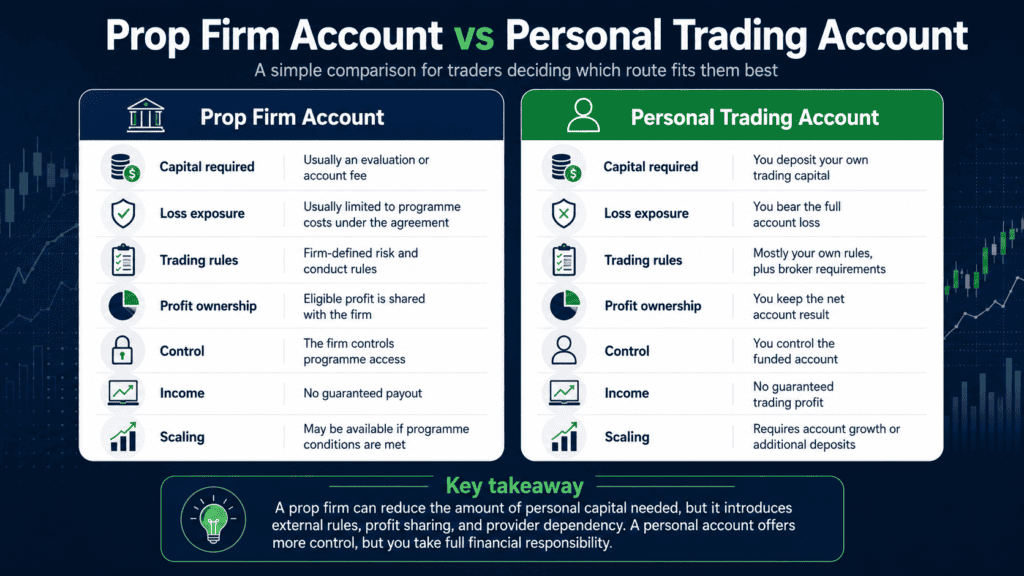
| Factor | Prop firm programme | Personal brokerage account |
|---|---|---|
| Capital required | Usually an evaluation or account fee | The trader deposits the complete trading capital |
| Loss exposure | Usually limited to programme costs under the applicable agreement | The trader bears the full account loss |
| Trading rules | Firm-defined risk and conduct rules | Mainly the trader’s own plan plus broker requirements |
| Profit ownership | Eligible profit is shared | The trader retains the net account result |
| Account control | The firm controls programme access | The trader controls the funded brokerage account |
| Income certainty | No guaranteed payout | No guaranteed trading profit |
| Provider dependency | Depends on the prop firm and its programme | Depends primarily on the broker and payment providers |
| Scaling | May be available under programme conditions | Requires additional deposits or account growth |
A prop firm may be more suitable when:
- you have limited personal trading capital;
- your strategy fits the programme rules;
- you are comfortable sharing profits;
- and you can follow strict external limits.
A personal account may be more suitable when:
- you have sufficient risk capital;
- you want full control over strategy and withdrawals;
- you need rules that a prop programme does not permit;
- or you prefer not to depend on an evaluation provider.
Some traders use both approaches. They may use a prop account for additional exposure while building a smaller personal account independently.
Who Is Prop Firm Trading Suitable For?
Prop trading may suit you when:
- you already have a documented trading strategy;
- you know your win rate and average reward-to-risk ratio;
- you understand your normal losing streaks;
- you calculate position size before entering;
- you can stop after reaching a daily limit;
- you do not depend on immediate payouts;
- you can afford to lose the evaluation fee;
- and the programme rules fit your normal method.
Prop trading may not suit you when:
- you are still learning basic execution;
- you frequently change strategy;
- you increase risk after losing;
- you need guaranteed monthly income;
- you dislike external trading restrictions;
- you rely on one unusually large trade;
- you cannot afford another failed challenge;
- or you have not tested the strategy across a meaningful sample.
Beginner warning
A prop firm challenge is usually a poor environment in which to learn basic trading. Use demo trading, a journal and position-size calculations before adding the pressure of a paid evaluation.
Compare prop firms for beginners only after you have established a repeatable risk process.
Is Prop Trading Worth It?
Prop trading can be worth considering when the programme gives a tested trader access to useful account exposure at a cost they can afford to lose.
It is less likely to be worthwhile when the trader repeatedly purchases challenges without reliable statistics or chooses firms based mainly on discounts and headline account sizes.
Use this five-part test
- Strategy fit: Does the firm allow your normal holding period, instruments, trading times and execution method?
- Risk fit: Can the strategy’s normal losing streak stay within the daily and maximum loss rules?
- Cost fit: Can you afford the full cost without needing to pass or receive a payout?
- Behaviour fit: Can you follow fixed risk limits without chasing the target?
- Provider fit: Are the rules, company information, support and payout conditions sufficiently clear?
When the answer to several of these questions is no, the sensible decision may be to delay the challenge, improve the strategy or choose a different programme.
How to Choose a Prop Firm After Weighing the Pros and Cons
Compare drawdown before profit split
The drawdown structure usually has a greater effect on account survival than a small difference in the advertised profit split.
Read the funded-stage rules
Do not evaluate only the challenge. Check the conditions that apply after qualification.
Match the account to your strategy
Consider:
- markets offered;
- overnight and weekend holding;
- news rules;
- platforms;
- trade-copying conditions;
- and drawdown calculation.
Calculate the complete cost
Include evaluation, activation, subscriptions, resets, data and platform charges.
Research the provider
Review the company information, terms, support options, complaint patterns and how clearly payout conditions are explained.
Start with an affordable account
The largest account is not necessarily the most suitable first challenge. Select a fee and risk structure you can treat as a genuine evaluation cost rather than money you must recover.
Research Your Options
Compare Prop Firms Read Prop Firm Reviews
Recommended Next Steps
Learn How Prop Firms Work
Understand challenges, funded accounts, payouts and the retail prop firm model.Read the Beginner Guide
Test Your Challenge Plan
Estimate how your strategy and risk settings could perform against evaluation limits. Calculate Your Pass Probability
Prepare for an Evaluation
Create a practical risk plan before paying for a challenge. Read the Challenge Guide
Compare Account Rules
Review selected prop firms and their key conditions side by side. Open the Comparison Tool
Prop Firm Pros and Cons FAQs
The main potential benefits are access to a larger notional account, reduced need to provide equivalent personal capital, defined risk limits, performance-based payouts and possible account scaling.
The principal disadvantages are evaluation costs, strict drawdown rules, profit sharing, restricted strategies, variable income and dependence on the firm to maintain the programme and process payouts.
It may be worthwhile for a trader with a tested strategy, limited personal capital and the discipline to follow strict rules. It is unlikely to be worthwhile when the trader is still learning or repeatedly buying challenges without correcting the cause of failure.
No. Traders can lose evaluation, activation, subscription and platform fees. They also risk spending time on an evaluation that does not produce a funded account or payout.
Prop firm payouts are not guaranteed and can vary considerably. Relying on them for essential expenses may create pressure to overtrade or increase risk.
It depends on the firm and account model. Some accounts are live, while others are simulated or form part of a wider risk-management arrangement. Read the programme agreement rather than assuming the displayed balance is live capital.
No. The trader normally receives an agreed share of eligible profits, subject to the programme’s payout conditions.
Beginners can purchase evaluations, but a paid challenge is generally not the best place to learn basic strategy, position sizing and emotional control.
Neither option is automatically better. A prop firm may require less personal capital but introduces external rules and profit sharing. A personal account provides more control but exposes the trader’s own money to the full result.
The account normally ends when a trader breaches a programme rule. The trader may need to purchase another evaluation or reset, depending on the provider’s terms.
Not necessarily. The account’s drawdown, fee, rules and payout conditions matter more than the headline balance alone.
Compare daily loss, maximum drawdown, profit targets, funded-stage rules, permitted strategies, platforms, total costs, payout conditions and the company behind the programme.
Editorial note: Prop firm fees, rules, platforms and payout conditions can change. Confirm the current terms of the specific programme before paying for an evaluation.
Last reviewed: June 2026. Published by Prop Firms Compare. This guide is provided for educational and research purposes and does not constitute financial advice. Trading involves a risk of loss.
Some links on this page are affiliate links. Prop Firms Compare may receive a commission if you purchase through them, at no additional cost to you. Commercial relationships do not determine our comparison criteria.