
Economic Calendar for Traders
Track major economic events, central bank decisions and high-impact market news before you trade with our economic calendar.
Economic Calendar for Prop Firm Traders
Use this economic calendar to track major market-moving events, including central bank decisions, inflation reports, employment data, GDP releases and high-impact forex news.
For prop firm traders, an economic calendar is not just useful for market analysis. It can also help you avoid unnecessary account breaches during volatile news releases, especially if your prop firm has rules around news trading, slippage, maximum drawdown or holding trades during major events.
Today’s Major Economic Events
Use the calendar above to check upcoming events by date, country, currency and expected impact. High-impact events can cause fast price movement, wider spreads and increased slippage, especially on forex pairs, indices, gold, oil and bond-sensitive markets.
Before opening a trade, check:
| What to check | Why it matters |
|---|---|
| Event time | Volatility can increase before and after the release |
| Currency affected | USD news can affect most major forex pairs, gold and indices |
| Expected impact | High-impact events usually create the biggest movement |
| Previous result | Helps traders understand the recent trend |
| Forecast | Markets often react to the difference between forecast and actual data |
| Actual result | The release can trigger sudden repricing |
| Prop firm rules | Some firms restrict trading around major news |
Why Prop Firm Traders Should Use an Economic Calendar
Prop firm traders need to manage risk more carefully than normal retail traders because one sharp move can breach a daily loss or maximum drawdown rule.
Even if your trade idea is valid, major news can create conditions that are difficult to control. Spreads may widen, stop losses may slip, and price can move sharply in both directions before choosing a clear direction.
This is especially important if you are trading:
| Trading style | Why the calendar matters |
|---|---|
| Scalping | Spreads and execution can change quickly during news |
| Day trading | Intraday setups can be invalidated by economic releases |
| Swing trading | Overnight or multi-day trades may be exposed to central bank or inflation events |
| News trading | Some prop firms restrict opening or closing trades around major announcements |
| Gold trading | XAU/USD can react strongly to inflation, jobs and interest-rate data |
| Index trading | Equity indices often react to rates, inflation and central bank guidance |
If you are comparing firms, check whether news trading is allowed before buying a challenge. You can compare rules using the prop firm comparison tool.
Major Economic Events to Watch
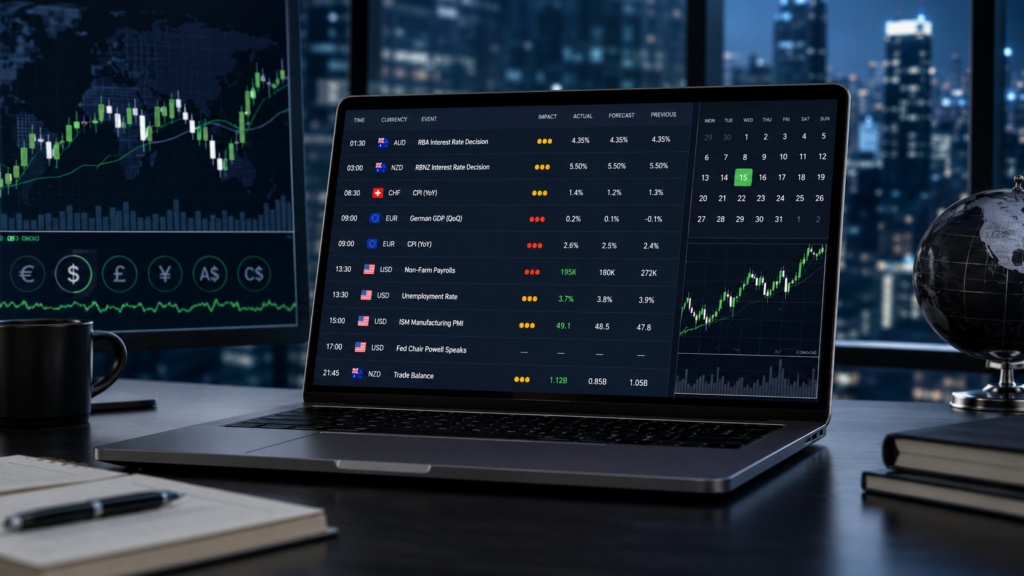
The most important events depend on what you trade, but the releases below are usually among the most watched by forex, index, commodities and prop firm traders.
| Event | Why traders watch it | Markets commonly affected |
|---|---|---|
| Interest rate decisions | Central banks influence currency strength, bond yields and risk sentiment | Forex, indices, gold, bonds |
| CPI inflation | Inflation can change expectations for future rate decisions | Forex, gold, indices |
| Non-Farm Payrolls | Major US employment report watched globally | USD pairs, gold, indices |
| Unemployment rate | Shows labour market strength or weakness | Forex, indices |
| GDP growth | Measures economic expansion or contraction | Currencies, indices |
| PMI data | Early signal of business activity | Forex, indices, commodities |
| Retail sales | Shows consumer spending strength | Forex, indices |
| PCE inflation | Key inflation measure watched by the Federal Reserve | USD, gold, indices |
| Central bank speeches | Can shift rate expectations before official decisions | Forex, bonds, indices |
| Crude oil inventories | Important for oil traders and CAD pairs | Oil, CAD, energy stocks |
How to Use the Economic Calendar Before Trading
1. Check high-impact events first
Start by filtering for high-impact events. These are the announcements most likely to cause fast market movement.
For example, if you trade EUR/USD, GBP/USD, USD/JPY, XAU/USD or US indices, pay close attention to major USD events such as inflation data, employment reports and Federal Reserve decisions.
2. Match the event to your open trades
Do not only check the country where you live. Check the currencies and markets you are trading.
For example:
| If you trade | Watch |
|---|---|
| EUR/USD | EUR and USD events |
| GBP/USD | GBP and USD events |
| XAU/USD | USD inflation, jobs and rate events |
| NASDAQ or S&P 500 | US inflation, jobs, rates and Fed speeches |
| Oil | Inventory data, OPEC news and USD events |
3. Check your prop firm’s news trading rules
Some prop firms allow news trading. Others restrict opening, closing or modifying trades around major events, especially on funded accounts.
Before trading news, check:
| Rule | What to confirm |
|---|---|
| News trading allowed? | Is it allowed in evaluation and funded stages? |
| Time restriction | Is there a ban before or after high-impact events? |
| Open trades | Can you hold trades through news? |
| Closing trades | Are manual closes restricted around releases? |
| Profit eligibility | Are news profits counted or excluded? |
| Account type | Do rules differ between standard, swing or instant accounts? |
If you are unsure which firm fits your style, start with the best prop firms for swing traders or compare firms side by side.
Economic Calendar and Risk Management
A calendar does not predict the market. It helps you identify when conditions may change quickly.
Before trading around major news, consider reducing risk or waiting until the release has passed. This is especially important during prop firm challenges where the daily loss limit can be tight.
Useful tools:
| Tool | How it helps |
|---|---|
| Position Size Calculator | Calculate lot size before entering a trade |
| Drawdown Calculator | Understand how losses affect your account |
| Profit Calculator | Estimate potential trade outcomes |
| Prop Firm Probability Calculator | Test whether your strategy fits a challenge target |
Economic Calendar for Forex Traders
Forex traders use economic calendars because currency prices react strongly to interest rates, inflation, employment data and central bank guidance.
The most important currencies to monitor are usually:
| Currency | Key events to watch |
|---|---|
| USD | Fed decisions, CPI, NFP, PCE, GDP, retail sales |
| EUR | ECB decisions, eurozone CPI, PMI, GDP |
| GBP | Bank of England decisions, UK CPI, jobs data, GDP |
| JPY | Bank of Japan decisions, inflation, GDP |
| CAD | Bank of Canada decisions, oil-related data, jobs reports |
| AUD | RBA decisions, employment, China-related data |
| NZD | RBNZ decisions, inflation, employment |
| CHF | SNB decisions, inflation, risk sentiment |
Should You Trade During High-Impact News?
Trading during high-impact news is not automatically wrong, but it is higher risk. Some traders specialise in news volatility, while others avoid it completely.
For most prop firm traders, the safer approach is to know when major releases are scheduled and decide in advance whether to trade, reduce size or stay out.
| Approach | Best for | Risk |
|---|---|---|
| Avoid trading news | Beginners and challenge accounts | Lower volatility exposure |
| Reduce position size | Experienced traders managing open positions | Still exposed to slippage |
| Trade after the release | Traders waiting for direction confirmation | May miss initial move |
| Trade the release directly | Specialist news traders | Highest execution and rule risk |
If your goal is to pass a challenge, protecting the account is usually more important than catching one high-volatility move.
Related Prop Firm Resources
If you are using the economic calendar because you trade funded accounts, these pages may help:
| Resource | Use it for |
|---|---|
| Compare Prop Firms | Compare rules, fees, payouts and platforms |
| Best Prop Firms | View overall rankings |
| Best Prop Firms for Beginners | Find beginner-friendly firms |
| Best Prop Firms for Swing Traders | Check overnight and weekend holding rules |
| How to Pass a Prop Firm Challenge | Improve your challenge preparation |
| Prop Trader Pros and Cons | Understand the risks before buying a challenge |
Economic Calendar FAQs
An economic calendar is a schedule of important financial events, data releases and central bank announcements. Traders use it to see when market-moving news is expected.
An economic calendar helps traders prepare for periods of higher volatility. Major events such as interest rate decisions, inflation reports and jobs data can move forex pairs, indices, commodities and gold very quickly.
High-impact events are announcements that are more likely to cause large market movement. Examples include central bank rate decisions, CPI inflation, Non-Farm Payrolls, GDP data and major employment reports.
Use a conservative return supported by a meaningful sample of net trading results. Do not use your best day or best month as though it will repeat consistently.
Some prop firms allow news trading, while others restrict trading around high-impact events. Rules can also differ between evaluation accounts and funded accounts, so always check the firm’s latest terms before trading.
Most beginners should be careful around high-impact news. Fast price movement, spread widening and slippage can make risk harder to control, especially during prop firm challenges.
The biggest forex events usually include interest rate decisions, inflation data, employment reports, GDP releases, PMI data and central bank speeches. Among the biggest ones are NFP, bank rates, Inflation rates.
No. An economic calendar shows when important events are scheduled, but it does not guarantee how the market will react. Markets often move based on how the actual result compares with expectations.
Active traders should check the economic calendar before every trading session. Swing traders should check the week ahead so they know which events could affect open trades.