
Forex Compound Calculator for Trading Account Growth
Unlock the Power of Compound Growth with our Forex Compound Calculator and see how much your money can grow over time.
Compound Calculator
Use this free forex compound calculator to estimate how a trading account could grow when profits remain in the account and future returns are calculated from the new balance.
Enter your starting balance, expected return per period and number of trading periods to compare different account-growth scenarios. The calculator can be used for forex, CFDs, futures, crypto and prop firm planning, but its results are projections rather than guaranteed returns.
Quick explanation: compounding means that each new percentage return is applied to your updated account balance. Profitable periods can increase the amount available for future trades, while losing periods reduce it.
The calculated figures are hypothetical. Real trading results vary because of losing trades, changing market conditions, withdrawals, fees, slippage and differences in risk exposure.
How to Use the Forex Compound Calculator
- Enter your starting account balance. This is the amount available at the beginning of the calculation. It could be a personal trading balance, a backtesting balance or the notional starting value of a prop firm account.
- Enter an expected return per period. Use a percentage that matches the period selected. For example, enter a monthly return only when the calculator is set to monthly periods.
- Choose the number of periods. A period may represent a trading day, week, month or year. For most trading plans, monthly periods are easier to compare with journal and broker-statement data.
- Calculate the projected account growth. Review the estimated final balance, total return and profit generated through compounding.
- Test more than one scenario. Compare a conservative, baseline and optimistic return rather than relying on one ideal result.
For a more useful projection, base the return input on a meaningful sample from your trading journal rather than your best month or a short winning streak.
What the Compound Calculator Results Mean
| Result | What it shows |
|---|---|
| Starting balance | The account value before any compounded returns are applied. |
| Return per period | The assumed percentage gain or loss for each selected period. |
| Number of periods | How many times the return is applied to the updated account balance. |
| Final balance | The projected account value at the end of the calculation. |
| Total profit | The difference between the starting balance and projected final balance. |
| Total percentage growth | The complete percentage change across all periods, rather than the return from one period. |
A projected final balance should not be treated as an earnings forecast. Its main purpose is to show how different return assumptions, time periods and risk decisions affect potential account growth.
How Does Compounding Work in Trading?
Compounding occurs when trading profits remain in the account and future returns are calculated from the updated balance.
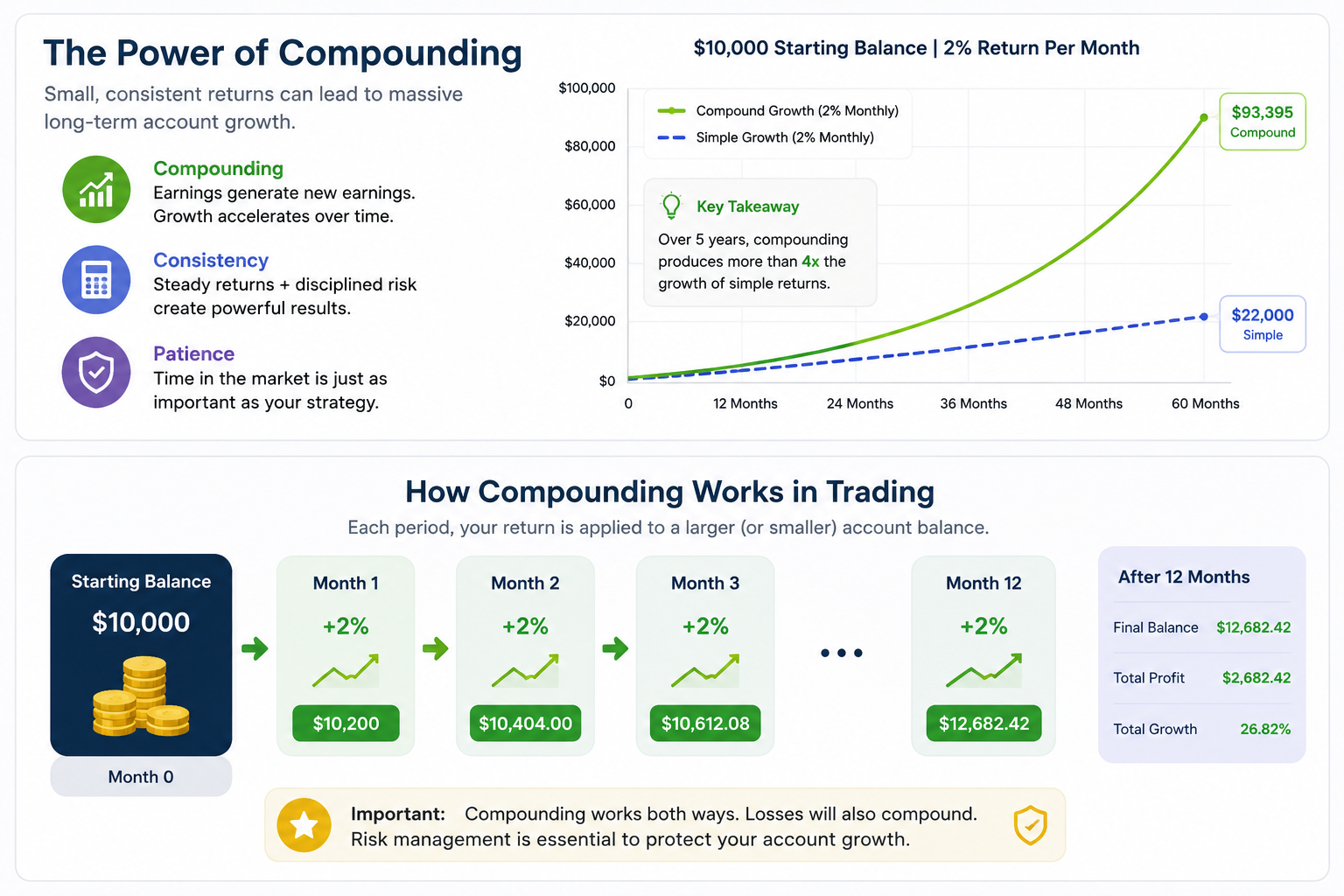
Consider a £10,000 account that gains 2% in its first month:
- Starting balance: £10,000
- First-month return: 2%
- Profit: £200
- New balance: £10,200
If the account earns another 2% during the second month, the calculation is based on £10,200 rather than the original £10,000. The second month would therefore generate £204 instead of £200.
After two profitable months, the projected balance would be £10,404. The additional £4 is the first visible effect of compounding.
Compound Return Formula
The basic compound return formula is:
Final balance = Starting balance × (1 + return per period)number of periods
It can also be written as:
A = P(1 + r)n
- A is the projected final balance.
- P is the starting balance.
- r is the percentage return per period expressed as a decimal.
- n is the number of compounding periods.
Forex compounding example
Assume a trader starts with £10,000 and uses an estimated monthly return of 2% for 12 months.
£10,000 × (1.02)12 = £12,682.42
Under that smooth hypothetical scenario:
- Starting balance: £10,000
- Projected final balance: £12,682.42
- Projected profit: £2,682.42
- Total projected growth: 26.82%
This does not mean a trader should expect to earn exactly 2% every month. The example only demonstrates how the compound return formula works.
Simple Returns Versus Compound Returns
Simple growth calculates each period’s profit from the original balance. Compound growth calculates it from the latest balance.
Using a £10,000 balance and a hypothetical 2% monthly return for 12 months:
| Calculation method | Final balance | Total profit |
|---|---|---|
| Simple return | £12,400.00 | £2,400.00 |
| Compound return | £12,682.42 | £2,682.42 |
The difference is £282.42 because the compound calculation includes returns generated from previously accumulated profit.
In practical trading, this effect usually occurs when position sizes are adjusted as the account balance changes. A trader who continues using exactly the same monetary risk or fixed lot size may not compound at the rate shown by a percentage-based projection.
Trading Account Growth Examples
The table below compares several hypothetical monthly returns on a £10,000 starting account over 12 months.
| Monthly return | Projected balance after 12 months | Projected profit | Total growth |
|---|---|---|---|
| 0.5% | £10,616.78 | £616.78 | 6.17% |
| 1% | £11,268.25 | £1,268.25 | 12.68% |
| 2% | £12,682.42 | £2,682.42 | 26.82% |
| 3% | £14,257.61 | £4,257.61 | 42.58% |
These figures assume that the same positive return is achieved every month, no money is withdrawn and no fees or losses occur. Real account growth is rarely this smooth.
A more realistic planning process should include flat months, losing months and changes in risk. Use the table as a comparison of mathematical scenarios rather than a trading target.
Is This a Compound Interest Calculator or a Trading Calculator?
The phrase compound interest calculator is commonly used when people search for this type of tool. However, a trader normally generates trading returns rather than receiving a fixed interest payment from a bank.
The mathematical process is similar: each new return is calculated from an updated balance. On this page, “compound interest” therefore refers to the compounding of hypothetical trading profits rather than a fixed or guaranteed interest rate.
This distinction matters because trading returns are variable. An investment account may experience positive, negative and flat periods, whereas a traditional compound-interest example often assumes a constant rate.
Daily, Weekly or Monthly Trading Compounding
The correct compounding frequency depends on how you measure your performance.
Daily compounding
Daily compounding may be useful when analysing a high-frequency strategy with reliable daily performance data. It can produce highly exaggerated projections when a single profitable day is entered as though it will repeat continuously.
Weekly compounding
Weekly periods can suit active traders who review performance at the end of each trading week. The percentage entered should represent an average weekly result rather than a daily target.
Monthly compounding
Monthly compounding is usually easier for longer-term planning because it reduces the impact of individual trades and aligns with monthly account statements and journal reviews.
More frequent compounding does not automatically make a strategy more profitable. The return input must correspond accurately with the selected period.
How Losing Periods Affect Compound Growth
A smooth compound-growth curve can hide the effect of drawdown. Real trading accounts do not only move upwards, and a percentage loss requires a larger percentage gain to recover.
| Account loss | Gain required to recover |
|---|---|
| 5% | 5.26% |
| 10% | 11.11% |
| 20% | 25% |
| 30% | 42.86% |
| 50% | 100% |
For example, a £10,000 account that loses 20% falls to £8,000. A 20% gain on £8,000 only increases the balance to £9,600, so a 25% recovery is required to return to £10,000.
Use the trading drawdown calculator to measure an account decline and calculate the gain needed to recover.
How Risk per Trade Affects Compounding
Compounding is closely connected with position sizing. When a trader risks a fixed percentage of the account, the monetary amount at risk normally changes as the balance changes.
For example:
- 1% of a £10,000 account is £100.
- 1% of a £12,000 account is £120.
- 1% of an £8,000 account is £80.
This means percentage-based risk can compound both account growth and account decline. Profitable periods increase the monetary exposure, while losses reduce the amount risked on subsequent trades.
Use the position size calculator to calculate an appropriate trade size from your account balance, risk percentage and stop-loss distance.
Can You Compound a Prop Firm Account?
This calculator can be used as a prop firm growth calculator, but the result needs to be interpreted carefully.
A prop firm account does not always work like a personal trading account. The balance displayed on the platform may be subject to payout rules, profit splits, scaling conditions and daily or overall drawdown limits.
Compounding may be possible when profits remain in the account and future position sizes are based on the updated balance. However, withdrawing profit reduces the balance available for continued compounding.
Before using the calculator for a challenge or funded account, check:
- whether profits increase the usable drawdown buffer;
- whether position size may be increased as the account grows;
- how withdrawals affect the displayed account balance;
- whether a consistency rule limits sudden increases in trade size;
- whether the programme uses static or trailing drawdown;
- and whether scaling is automatic or requires additional conditions.
Do not assume that a projected account balance is the amount you would personally receive. Profit splits, withdrawals and programme rules can produce a different outcome.
Use our prop firm comparison tool to compare account conditions before purchasing a challenge.
How to Create a Realistic Trading Growth Projection
1. Use data from a meaningful sample
A projection based on one winning week is unlikely to represent long-term performance. Use a larger collection of live or backtested trades that includes different market conditions.
2. Use your average compounded return
A simple average can overstate growth when results vary significantly. Review the actual change in account equity across the full period wherever possible.
3. Include losing and flat periods
Test what happens when several periods produce no growth or negative returns. This gives you a more useful range than a perfectly smooth upward projection.
4. Account for withdrawals
Any profit removed from the account is no longer available to generate future returns. A trader withdrawing monthly income will normally compound more slowly than a trader leaving all profits in the account.
5. Account for trading costs
Commissions, spreads, swaps, platform fees and slippage reduce net returns. Use returns after normal trading costs rather than gross strategy results.
6. Keep risk consistent with the strategy
Do not enter an ambitious return while ignoring the drawdown and trade exposure required to pursue it. Projected growth should be evaluated alongside expected risk.
7. Recalculate as new data becomes available
A compound calculation is a planning model, not a fixed forecast. Update your assumptions when your journal produces a larger and more representative sample.
Our guide to creating a trading plan explains how to document risk, entry criteria, performance targets and review rules.
Three Scenarios Worth Testing
Instead of calculating only your preferred outcome, create three versions:
| Scenario | Suggested purpose |
|---|---|
| Conservative | Uses a return below your historical average and includes withdrawals or losing periods. |
| Baseline | Uses a return supported by a meaningful sample of net trading results. |
| Optimistic | Shows the outcome of stronger performance without treating it as the expected result. |
This range can help you see whether your plan still makes sense when results are slower than expected.
Compound Calculator Limitations
A compound returns calculator is useful for mathematical projections, but it cannot predict:
- your future win rate;
- the sequence of winning and losing trades;
- maximum future drawdown;
- changes in spreads or market volatility;
- slippage and execution quality;
- psychological or execution mistakes;
- prop firm rule changes;
- or whether a strategy will remain profitable.
The output is only as useful as the assumptions entered. An unrealistic return produces an unrealistic final balance, even when the calculation itself is mathematically correct.
Related Trading Calculators
- Drawdown Calculator: calculate account drawdown and the return needed to recover.
- Position Size Calculator: calculate trade size from account risk and stop-loss distance.
- Forex Profit Calculator: estimate potential profit or loss from a proposed trade.
- Prop Firm Probability Calculator: estimate the probability of reaching a challenge target before breaching a loss limit.
- Trading Tools: view all free Prop Firms Compare calculators.
Last reviewed: June 2026. This calculator is provided for educational and planning purposes. It does not predict future returns or constitute financial advice. Trading involves a risk of loss, and prop firm rules can change.
Some related pages may contain affiliate links. Prop Firms Compare may receive a commission if you purchase through one of these links, at no additional cost to you.
Forex Compound Calculator FAQs
A forex compound calculator estimates how a trading account could grow when profits remain in the account and each new percentage return is applied to the updated balance.
Multiply the starting balance by one plus the return per period, raised to the number of periods. The formula is A = P(1 + r)n.
No. The calculator provides a mathematical projection based on the values entered. Real trading includes losses, variable returns, costs and drawdown.
Use a conservative return supported by a meaningful sample of net trading results. Do not use your best day or best month as though it will repeat consistently.
Use the period that matches your performance data. Monthly periods are often more practical for longer-term planning, while daily calculations require reliable daily results and can create exaggerated projections.
Simple returns calculate each period’s profit from the original balance. Compound returns calculate each period’s result from the updated balance, including previous profits and losses.
Yes, but the projected balance may not represent your personal payout. You must also consider profit splits, withdrawals, drawdown rules, consistency requirements and scaling conditions.
Yes. Money withdrawn from the account is no longer available to produce future returns, so regular withdrawals generally reduce the rate of account compounding.
Not necessarily. Compounding normally requires the monetary position size or risk to change with the account balance. Continuing to use the same fixed lot size can produce a different growth pattern.
Yes. The compound return formula is not limited to forex. It can model hypothetical account growth for any market where returns are expressed as a percentage of the account balance.
The calculator assumes the return entered is repeated according to the selected settings. Real accounts experience varying returns, losses, fees, withdrawals and changes in trade exposure.