
How to pass a Prop Firm Challenge: A Practical 10-Step plan
To pass a prop firm challenge, you need more than a profitable strategy. You must reach the required target while staying inside the firm’s daily loss, maximum drawdown and trading rules.
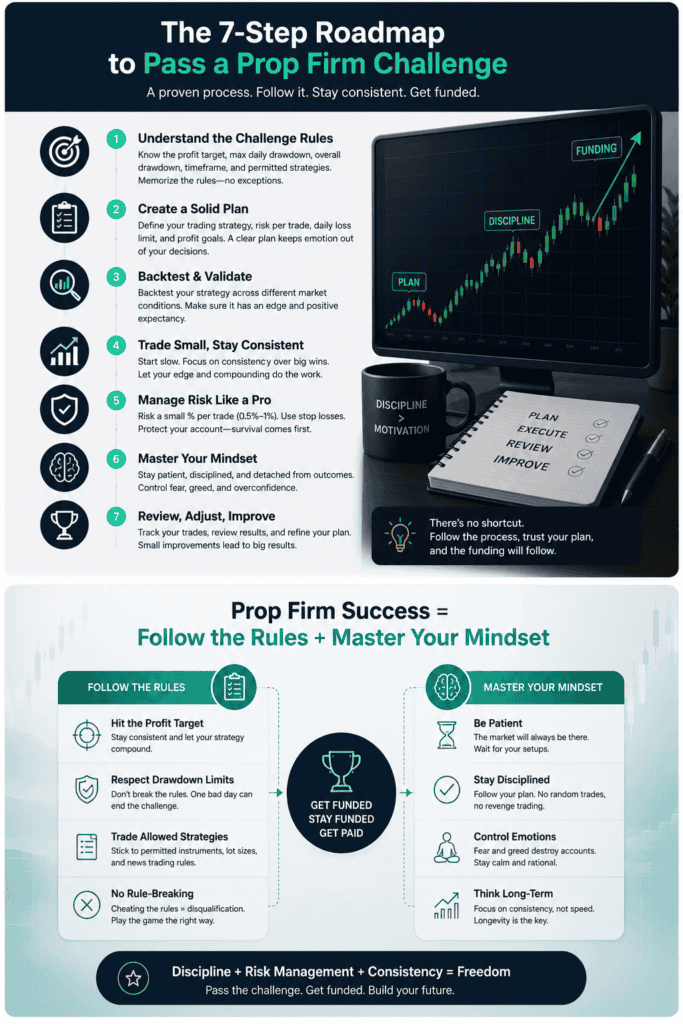
The most practical approach is to choose a challenge that fits your strategy, calculate a risk level that can survive normal losing streaks and follow the same process until the evaluation is complete.
The quick answer: use a tested strategy, risk a consistent amount on every trade, set your own daily stop below the firm’s official limit and avoid increasing exposure to reach the target faster.
This guide explains how to build that plan, calculate your risk and avoid the mistakes that commonly end otherwise manageable challenges.
On this page
- What passing a challenge requires
- What to check before buying
- The 10-step passing plan
- How much to risk per trade
- Worked challenge example
- The best challenge strategy
- Managing losing streaks
- Common challenge mistakes
- Challenge-readiness checklist
- Frequently asked questions
Prop Firm Challenge Plan in 60 Seconds
- Choose rules that match how you already trade.
- Read both the evaluation and funded-stage terms.
- Use statistics from your journal or backtest.
- Convert the profit target and drawdown limits into R-multiples.
- Set a personal daily stop below the official daily loss limit.
- Calculate position size before every trade.
- Limit total exposure across correlated positions.
- Trade only setups included in your tested plan.
- Reduce activity after reaching your personal daily stop.
- Do not increase risk simply because the target is close.
What Does It Take to Pass a Prop Firm Challenge?
A prop firm challenge normally requires a trader to reach a profit target without breaching the account’s risk or conduct rules.
Depending on the programme, those conditions may include:
- a phase-one profit target;
- a second evaluation target;
- a maximum daily loss;
- a maximum overall or trailing drawdown;
- minimum profitable or trading days;
- consistency requirements;
- restrictions around news events;
- overnight or weekend holding rules;
- limits on expert advisers or trade copying;
- and funded-stage payout conditions.
Passing is therefore a path-dependent problem. A strategy can be profitable across 100 trades but still fail an evaluation if several losses arrive close together or one trading day exceeds the permitted limit.
Your objective is not simply to make the target. It is to give your strategy enough room to reach the target without an ordinary losing sequence ending the account first.
What to Check Before Buying a Challenge
The best time to improve your chance of passing is before you pay the fee. A well-matched challenge is easier to manage than one whose rules conflict with your strategy.
1. The drawdown calculation
Confirm whether the maximum loss is:
- static;
- trailing in real time;
- updated at the end of the day;
- calculated from balance;
- or calculated from equity.
This can materially affect how much room open positions have before an account breach.
2. The daily reset time
Check when a new trading day begins under the firm’s rules. Do not assume that the reset follows your local midnight.
Also confirm whether open losses, commissions and swap charges count towards the daily limit.
3. Trading restrictions
Check whether your normal strategy requires:
- news trading;
- overnight holding;
- weekend holding;
- scalping;
- expert advisers;
- trade copying;
- or unusually large position sizes.
Do not purchase a challenge and then attempt to modify your entire strategy to fit its restrictions.
4. Evaluation and funded-stage differences
Some programmes apply different rules after the trader passes. Review the funded-stage drawdown, consistency, payout and prohibited-trading terms before starting the evaluation.
5. The total cost
Consider the challenge fee, activation fee, recurring charges, platform costs and the possibility of needing another attempt.
Compare the Rules Before Choosing
Compare drawdown limits, account options and important conditions before purchasing a challenge.
Compare Prop Firms Side by Side View Prop Firms for Beginners
How to Pass a Prop Firm Challenge: 10 Practical Steps
Step 1: Choose a Challenge That Fits Your Existing Strategy
A challenge should match the way you already trade. It should not force you to abandon a tested process simply because the fee or advertised account size looks attractive.
For example:
- A swing trader may need overnight and weekend holding.
- A news trader needs clear permission to trade around economic announcements.
- A scalper needs suitable execution, spreads and platform rules.
- A futures trader needs the required exchange data and contract availability.
If your strategy does not fit the programme, passing becomes partly dependent on learning a new approach under financial and time pressure.
Step 2: Create a One-Page Rule Sheet
Do not rely on memory or a marketing summary. Write the important account conditions on one page and keep it visible while trading.
Your sheet should include:
- profit target;
- daily loss limit;
- maximum loss or trailing threshold;
- daily reset time;
- minimum trading days;
- consistency rules;
- news restrictions;
- holding restrictions;
- maximum position exposure;
- and any prohibited strategies.
Record the source and date checked. Prop firm rules can change, so confirm them again immediately before buying.
Step 3: Validate Your Strategy Before Starting
A challenge should test an existing process, not become the place where you discover whether a strategy works.
Before starting, you should know:
- your historical win rate;
- average winning trade;
- average losing trade;
- average reward-to-risk ratio;
- maximum historical losing streak;
- maximum historical drawdown;
- trades taken per week;
- and the market conditions in which the strategy performs poorly.
A small sample can be misleading. Use enough trades to include losing periods and different market conditions.
When the statistics are not strong enough to support a risk plan, continue testing rather than purchasing repeated challenges.
Step 4: Convert the Challenge Into R-Multiples
An R-multiple expresses the result of a trade relative to the amount risked.
- A full stop loss equals −1R.
- A winning trade twice the initial risk equals +2R.
- A partial loss of half the initial risk equals −0.5R.
Converting the target into R makes it easier to see how demanding the challenge is at your chosen risk level.
For example, if:
- the profit target is 8%;
- and you risk 0.5% per trade;
you need a net result of:
8% ÷ 0.5% = +16R
This does not mean you need eight 2R winners. Any losses must also be deducted. The full trading sequence must finish at a net +16R.
Step 5: Set Risk per Trade From the Drawdown Limit
Do not select risk per trade from the profit target alone. Start with the maximum loss and work backwards.
Your risk should give the strategy enough room to survive a losing streak without approaching the breach threshold.
Consider:
- your worst historical losing streak;
- the number of positions you may hold together;
- correlation between those positions;
- slippage and trading costs;
- and whether open equity counts towards the loss limit.
Use the forex position size calculator before every trade to convert the chosen risk into an appropriate lot size.
Step 6: Set a Personal Daily Stop
The firm’s official daily loss limit should not become your normal daily stop.
Create a personal limit below it. This gives you room for:
- commissions;
- spread expansion;
- slippage;
- floating losses;
- and calculation differences.
Your personal stop could be defined by:
- a maximum percentage loss;
- a maximum number of losing trades;
- or whichever condition occurs first.
For example, a trader might stop after losing 1% or after two full losses, even if the firm allows a larger daily decline.
The exact number must come from the strategy and account rules rather than a universal rule copied from another trader.
Step 7: Control Total Open Risk
Risk per trade is only one part of account exposure.
Suppose you open:
- EUR/USD risking 0.5%;
- GBP/USD risking 0.5%;
- gold risking 0.5%;
The account may have 1.5% of open risk. If all three positions depend on a similar US-dollar movement, the exposure may also be highly correlated.
Set a maximum total open risk and reduce individual positions when trades are related.
Do not assume that three trades are diversified simply because they use different symbols.
Step 8: Trade Only the Setups Included in Your Data
The challenge target can make average setups look more attractive than they are.
Define your acceptable setups before the challenge begins. Your plan should cover:
- markets traded;
- trading sessions;
- entry conditions;
- stop placement;
- profit-taking rules;
- maximum trades per day;
- and conditions that require you to stay out.
A missed trade does not damage the account. A low-quality trade can.
Step 9: Use a Fixed Review Routine
Journal each trade using the same information:
- setup taken;
- entry and exit;
- planned and realised R;
- risk percentage;
- screenshot;
- whether every rule was followed;
- and whether emotion changed the decision.
Review execution separately from outcome.
A losing trade that followed the plan may be acceptable. A winning trade that broke the rules is still a process failure and can encourage more dangerous behaviour later.
Step 10: Protect the Account When the Target Is Close
Traders often increase risk when they are close to passing because the remaining target appears small.
That can reverse several weeks of progress in one session.
When approaching the target:
- keep the same risk or reduce it;
- continue taking only planned setups;
- check whether consistency rules apply;
- avoid trading only to finish that day;
- and confirm the account’s current equity before placing another position.
Passing one day later is usually preferable to restarting the entire challenge.
How Much Should You Risk per Trade?
There is no risk percentage that is suitable for every strategy or challenge.
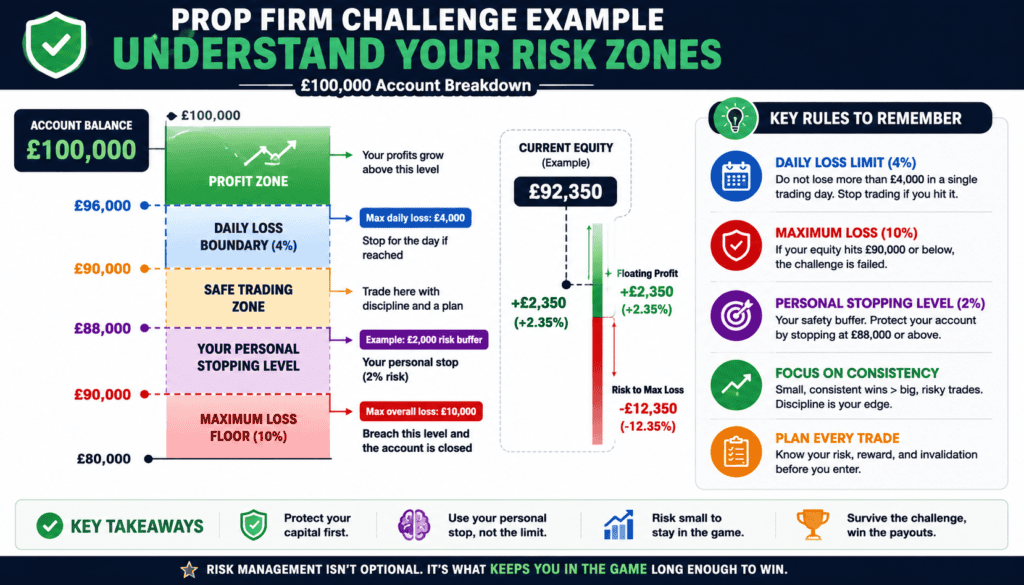
Lower risk normally gives the account more room to survive losing streaks, but it also means that more net R is required to reach the profit target. Higher risk can reach the target faster, but a short adverse sequence can consume the drawdown allowance quickly.
The table below uses a fictional £100,000 account with a 10% maximum loss limit.
| Risk per trade | Monetary risk | Full losses equal to 10% | 8% target expressed in R |
|---|---|---|---|
| 0.25% | £250 | 40 | +32R |
| 0.50% | £500 | 20 | +16R |
| 1.00% | £1,000 | 10 | +8R |
| 2.00% | £2,000 | 5 | +4R |
This is a simplified illustration. A real account can breach sooner because of the daily loss limit, open positions, costs, slippage, trailing drawdown or correlated trades.
Risk should therefore be selected using the complete account rules and your own strategy statistics.
Test Your Risk Before Starting
Estimate how your win rate, average reward, risk per trade and drawdown limits could affect the chance of reaching the target.
Use the Prop Firm Probability Calculator
You can also receive the free Prop Firm Challenge Plan after completing the calculator.
Worked Prop Firm Challenge Example
Consider a fictional challenge with the following rules:
| Account condition | Example |
|---|---|
| Starting account value | £100,000 |
| Profit target | 8% |
| Maximum daily loss | 4% |
| Maximum overall loss | 10% |
| Chosen risk per trade | 0.5% |
| Personal daily stop | 1% |
| Maximum open risk | 1% |
At 0.5% risk per trade:
- one full loss equals −0.5% or −1R;
- a 1.5R winner equals +0.75%;
- a 2R winner equals +1%;
- and the 8% target requires a net +16R.
The trader might limit the day to two full losing trades. After reaching −1%, trading stops even though the firm’s official daily limit is larger.
The trader also avoids opening two positions risking 0.5% each when both are strongly correlated with the same market movement.
Example sequence
Assume the trader completes 20 trades with these results:
- 10 winners averaging +1.8R = +18R;
- 8 full losses = −8R;
- 2 break-even trades = 0R.
The net result is:
+18R − 8R = +10R
At 0.5% risk per R, that equates to approximately +5% before costs and any compounding effects.
The strategy has made progress but has not passed yet. The trader should continue using the same process rather than increasing risk to force the remaining 3%.
This example shows why the journey to the target matters. Win rate alone does not determine the result; average reward, losing sequences, risk and rule compliance also matter.
What Is the Best Strategy to Pass a Prop Firm Challenge?
The best strategy is normally the one you have already tested, understand and can execute consistently within the account rules.
A breakout, trend-following, mean-reversion or swing strategy is not automatically better simply because another trader has used it to pass.
A challenge-suitable strategy should ideally have:
- clear entry and exit rules;
- a defined stop or invalidation point;
- a measurable historical edge;
- manageable drawdown;
- enough trading opportunities to reach the target;
- and compatibility with the firm’s restrictions.
Characteristics to avoid
Be cautious when the strategy depends on:
- doubling position size after losses;
- very high correlated exposure;
- holding through restricted events;
- one unusually large trade;
- extreme leverage;
- or market conditions that appeared only in a short backtest.
Should you change strategy during a challenge?
Only when your predefined plan requires it.
Changing strategy because of two or three losses usually replaces a tested process with an untested response. If the strategy is genuinely unsuitable, pause the challenge and reassess rather than improvising with live account limits.
How to Handle a Losing Streak During a Challenge
Losing streaks are part of trading, including for strategies with positive long-term expectancy.
Your plan should define what happens before a losing streak occurs.
After one normal loss
- Record the trade.
- Check that the setup and risk followed the plan.
- Take another trade only when a valid setup appears.
After reaching the personal daily stop
- Stop trading for the day.
- Do not attempt to recover before the official reset.
- Review whether the losses were strategy variance or execution errors.
After several losing days
- Calculate the current drawdown.
- Compare it with the strategy’s historical range.
- Reduce risk only according to a predefined rule.
- Check for changing market conditions.
- Pause when execution or emotional control has deteriorated.
Use the trading drawdown calculator to measure the account decline and see the return required to recover.
Our guide to managing trading losing streaks covers the probability and behavioural side in more detail.
Common Reasons Traders Fail Prop Firm Challenges
Buying a challenge without reliable statistics
Without a measured win rate, average reward and losing-streak history, the risk plan is mostly guesswork.
Using the headline account size as risk capital
A £100,000 account does not usually allow a trader to lose £100,000. The daily and maximum loss limits define the practical risk budget.
Risking too much to pass quickly
Higher risk reduces the number of losing trades the account can survive.
Ignoring floating equity
Open positions may count towards daily or overall limits even when the trades have not been closed.
Treating the official loss limit as the personal stop
This leaves no buffer for slippage, costs or calculation differences.
Stacking correlated positions
Several trades can become one large market bet when they respond to the same currency or economic theme.
Trading simply because the target is close
The remaining target does not create a valid setup.
Increasing risk after a loss
Recovery trading can turn a normal losing day into an account breach.
Changing strategy during normal variance
A few losses do not automatically invalidate a tested strategy.
Reading only the evaluation rules
Passing the challenge is less valuable when the funded-stage rules do not suit the trader.
Repeating challenges without changing the plan
A new account does not correct excessive risk, an untested strategy or repeated rule-breaking.
Read why funded traders lose their accounts for a wider analysis of the mistakes that continue after an evaluation has been passed.
How Long Does It Take to Pass a Prop Firm Challenge?
There is no reliable universal timeframe.
The time required depends on:
- the profit target
- risk per trade
- average strategy expectancy
- number of valid setups
- minimum trading-day rules
- the order of winning and losing trades
- and whether the trader follows the plan consistently.
A trader who takes two valid setups per week may need longer than someone whose strategy produces two opportunities per day. That does not make the slower strategy worse.
A useful target is to execute the plan correctly rather than pass by a chosen date. Deadlines created by the trader can encourage unnecessary trades and excessive risk.
Passing a One-Step Versus Two-Step Challenge
One-step challenges
A one-step evaluation requires one set of passing conditions before the funded stage.
Advantages may include fewer phases and a shorter route to qualification. However, the programme can have different pricing, drawdown or consistency conditions.
Two-step challenges
A two-step evaluation requires the trader to complete two separate phases.
The second phase should not be treated as an invitation to increase risk because phase one was successful. The trader still needs to preserve the account and follow the applicable target and drawdown rules.
Which is easier?
Neither format is automatically easier.
Compare:
- total targets across both phases;
- drawdown method;
- daily loss limit;
- minimum trading days;
- consistency rules;
- fee structure;
- and funded-stage conditions.
The easier programme is the one whose complete rules are more compatible with your trading data.
Prop Firm Challenge Readiness Checklist
Before paying for an evaluation, confirm that you can answer yes to most of the following:
- I have a written trading plan.
- I have tested the strategy over a meaningful trade sample.
- I know my historical win rate.
- I know my average realised winner and loss.
- I know my normal losing streak.
- I know my maximum historical drawdown.
- I have calculated the target in R-multiples.
- I have chosen risk per trade from the drawdown limit.
- I have a personal daily stop below the firm’s limit.
- I have set a maximum total open risk.
- I understand how correlated positions affect exposure.
- I understand the daily reset time.
- I know whether the drawdown is static or trailing.
- I know whether floating losses count.
- I have read the funded-stage and payout rules.
- I can afford to lose the evaluation fee.
- I do not need to pass by a specific date.
- I have tested the complete plan on a demo or simulated account.
Get Your Free Prop Firm Challenge Plan
Use the probability calculator to test your statistics and receive a practical challenge plan covering risk per trade, daily stopping rules and challenge preparation.
Choose a Prop Firm That Fits Your Plan
A good risk plan cannot compensate for unsuitable account rules. Once your challenge strategy is ready, compare firms based on drawdown, platforms, holding rules, fees and funded-stage conditions.
Compare Firms
Review selected programmes and account conditions side by side. Open the Comparison Tool
View the Rankings
Explore our overall assessment of selected prop trading firms. View the Best Prop Firms
Read Detailed Reviews
Research individual firms, account models, rules and potential drawbacks. Browse Prop Firm Reviews
Compare Lower-Cost Options
Review challenge costs without judging the programmes solely by price. View Cheap Prop Firms
How to Pass a Prop Firm Challenge FAQs
The best approach is to use a tested strategy, choose rules that match it, risk a consistent amount per trade and stop trading before reaching the firm’s official daily limit.
There is no universal best strategy. Use a strategy with clear rules, measured performance and manageable drawdown that fits the firm’s holding, news and execution conditions.
The correct percentage depends on the maximum drawdown, daily loss limit, historical losing streak and number of positions held together. Test several risk levels using your actual strategy statistics rather than copying a universal percentage.
Potentially. A strategy with a lower win rate can remain profitable when its average winning trade is sufficiently larger than its average loss. The order of outcomes and drawdown limits also affect challenge survival.
It depends on the target, strategy expectancy, trading frequency, risk and sequence of results. Passing by a fixed deadline should not take priority over following the trading plan.
There is no single independently audited pass rate covering the entire industry. Figures can vary by firm, account type, period and how resets or repeat attempts are counted.
Usually not. Increasing risk near the target can erase previous progress quickly. Maintain the same process or reduce risk when doing so is part of your original plan.
One normal loss does not automatically require stopping. Stop when you reach the personal daily limit, lose execution discipline or encounter a condition defined in your trading plan.
Only when the specific programme permits it. Check whether restrictions apply to opening, closing or holding positions around selected announcements and whether the funded-stage rules differ.
The account normally ends when a rule is breached or the applicable conditions are not met. Before purchasing another attempt, identify whether the failure came from strategy variance, excessive risk, unclear rules or inconsistent execution.
Not necessarily. Compare the total profit targets, drawdown structure, consistency rules, costs and funded-stage conditions rather than judging difficulty only by the number of phases.
Yes. A profitable long-term strategy can experience a short losing sequence that reaches a daily or overall account limit before the profit target is achieved.
A beginner should first understand position sizing, drawdown and their strategy statistics. A paid evaluation is generally not the best place to learn basic trading execution.
This depends on the strategy and firm rules, but every trade should have a defined maximum acceptable risk. A stop loss can help control that risk, although gaps and slippage mean execution is not guaranteed at the exact price.
Editorial note: Prop firm rules, fees, account models and payout conditions can change. Confirm the current terms of the specific programme before purchasing or trading an account.
Last reviewed: June 2026. Published by Prop Firms Compare. This guide is provided for educational and planning purposes and does not constitute financial advice. Trading involves a risk of loss.
Some links on this page are affiliate links. Prop Firms Compare may receive a commission if you purchase through them, at no additional cost to you. Commercial relationships do not determine our comparison criteria.