
What is a Prop Firm? How Funded Trading works for beginners.

Christian Preciado
Co-founder & Lead Researcher at PropFirmsCompare
Christian is the co‑founder and lead researcher at PropFirmsCompare, specialising in prop firm evaluations, trading rules, and payout reliability. With hands‑on experience at Glencore in institutional commodity trading, he brings real‑market insight to every review. He has personally tested dozens of prop firms, focusing on transparency, trader‑first policies, and long‑term funding success
View full bio →
A prop firm, short for proprietary trading firm, is a business that allows traders to operate under its trading programme and earn a share of eligible profits while following defined risk rules.
For retail traders, this usually means completing a paid evaluation or choosing an instant funding programme before becoming eligible for a funded-stage account. The trader does not simply receive unrestricted money. They must follow rules covering drawdown, position risk, trading behaviour and payouts.

In practical terms: the firm provides the account programme and risk limits; the trader provides the strategy, execution and discipline. If the trader meets the programme conditions and generates eligible profit, the firm may pay them an agreed share.
This guide explains how modern retail prop firms work, what a prop firm challenge involves, how payouts and loss limits operate and what a beginner should check before paying for an account.
On this page
- What does prop firm mean?
- Traditional versus retail prop firms
- How prop firms work
- What a prop firm challenge is
- Important prop firm rules
- Fees, payouts and profit splits
- Whether prop firms suit beginners
- How to choose a prop firm
- Frequently asked questions
Prop Firms in 60 Seconds
- A prop firm gives traders access to a trading programme under defined risk limits.
- Most online retail firms require an evaluation fee or account fee.
- Traders normally need to reach a profit target without breaking drawdown rules.
- A funded account may be simulated or connected to live market execution, depending on the firm and programme.
- Passing an evaluation does not guarantee future payouts or long-term profitability.
- The advertised account size is not the same as the amount a trader can afford to lose.
- Daily loss and maximum drawdown rules are usually more important than the headline account size.
- Rules, account availability and payout conditions vary considerably between programmes.
What Does Prop Firm Mean?
“Prop firm” is an abbreviation of proprietary trading firm. Proprietary trading traditionally means that a company trades financial markets for its own benefit rather than placing trades on behalf of outside clients.
The firm attempts to earn trading profits using its own capital, traders, systems and risk-management processes.
However, when retail traders use the term “prop firm” today, they are often referring to an online funded-trader business rather than a traditional institutional trading company.
These online firms typically offer an evaluation programme. A retail trader pays a fee, trades under simulated or programme-specific conditions and attempts to meet a profit target without breaching the stated loss limits.
Successful traders may then become eligible for a funded-stage account and a share of eligible profits.
Simple prop firm definition
A prop firm is a company that evaluates or allocates traders under a set of risk rules and may share eligible trading profits with traders who satisfy its conditions.
Traditional Prop Firms Versus Online Retail Prop Firms
The phrase “prop firm” now covers two models that should not be treated as identical.
| Feature | Traditional proprietary trading firm | Online retail prop firm |
|---|---|---|
| Trader relationship | The trader may be an employee, contractor or professional firm member. | The trader usually purchases access to an evaluation or account programme. |
| Selection process | Recruitment, interviews, qualifications, track record and internal training may be used. | Selection normally happens through a rules-based trading challenge or assessment. |
| Trading environment | Often involves internal systems, professional infrastructure and direct company oversight. | Usually accessed remotely through a supported retail trading platform. |
| Account type | Trades may be placed directly with company capital. | Evaluation and funded-stage accounts may be simulated, live or managed through a hybrid model. |
| Trader cost | The trader may not pay an evaluation fee. | The trader commonly pays a challenge, activation or recurring account fee. |
| Payment | Salary, bonus, partnership share or trading-profit compensation may apply. | Payment usually takes the form of a defined share of eligible account profits. |
Prop Firms Compare primarily covers the online retail funded-trader model. That is the model used by traders searching for challenges, instant funding accounts, drawdown limits and funded account payouts.
This distinction matters because buying a retail prop firm challenge is not the same as accepting a trading job. You are usually purchasing access to an assessment governed by contractual terms.
How Do Prop Firms Work?
Although programmes differ, the typical retail prop firm process follows five stages.
1. The trader chooses a firm and account programme
The trader compares firms, account sizes, evaluation formats, trading platforms, markets, profit targets, loss limits and fees.
A beginner should not choose an account based only on the largest advertised balance or the lowest price. The programme must fit the trader’s strategy and normal holding period.
2. The trader pays for an evaluation or account
Most challenge-based programmes charge an upfront evaluation fee. Some instant funding programmes charge for direct access to an account with different restrictions.
The payment is normally a programme or assessment fee. It should not be assumed to be money deposited into a personal brokerage account.
3. The trader follows the programme rules
The trader places trades using the supported platform and attempts to reach the required target without breaching any rules.
Common restrictions include:
- maximum daily loss;
- maximum overall drawdown;
- minimum trading days;
- consistency requirements;
- limits on holding during news;
- overnight or weekend restrictions;
- maximum position exposure;
- and restrictions on certain strategies or software.
4. The trader qualifies for the funded stage
If the trader meets the required conditions, the firm reviews the account. The trader may need to complete identity checks, sign an agreement or pay an activation fee before receiving the next account.
The funded-stage account may operate differently from the evaluation. Traders should check whether its drawdown, payout, consistency or trading rules change.
5. The trader requests a payout
If the trader generates eligible profit while following the funded-stage rules, they may request a payout according to the programme’s schedule.
The firm applies the agreed profit split and may complete additional checks before approving payment.
Ready to Explore Your Options?
Compare account rules and important programme features before deciding which firm deserves further research.
Compare Prop Firms Side by Side View Prop Firms for Beginners
What Is a Prop Firm Challenge?
A prop firm challenge is a trading evaluation used to assess whether a trader can reach a target while remaining within the programme’s risk limits.
The challenge is not only a test of whether a strategy can make money. It also tests whether the trader can control losses and follow the account rules.
One-step challenges
A one-step challenge has one evaluation phase. The trader must meet that phase’s conditions before moving to the funded stage.
One-step does not automatically mean easier. The account may have tighter risk conditions, different pricing or additional consistency requirements.
Two-step challenges
A two-step challenge separates the evaluation into two phases. The first phase commonly focuses on reaching an initial target, while the second attempts to confirm consistency under another set of conditions.
Both phases must normally be completed without breaking the applicable rules.
Instant funding accounts
An instant funding account removes the traditional multi-stage challenge. The trader receives access to an account programme immediately after purchasing it and completing any required checks.
These accounts can have different drawdown structures, payout conditions, fees or scaling rules. “Instant” should not be interpreted as unrestricted access to withdrawable capital.
Traders considering this route can review our instant funding prop firm comparison.
Hypothetical challenge example
Consider a fictional challenge with the following conditions:
| Rule | Hypothetical condition |
|---|---|
| Starting account value | £100,000 |
| Profit target | 8% |
| Maximum daily loss | 4% |
| Maximum overall loss | 8% |
| Minimum trading days | 5 |
The trader would need to produce £8,000 of qualifying profit without exceeding either loss threshold or breaking another programme rule.
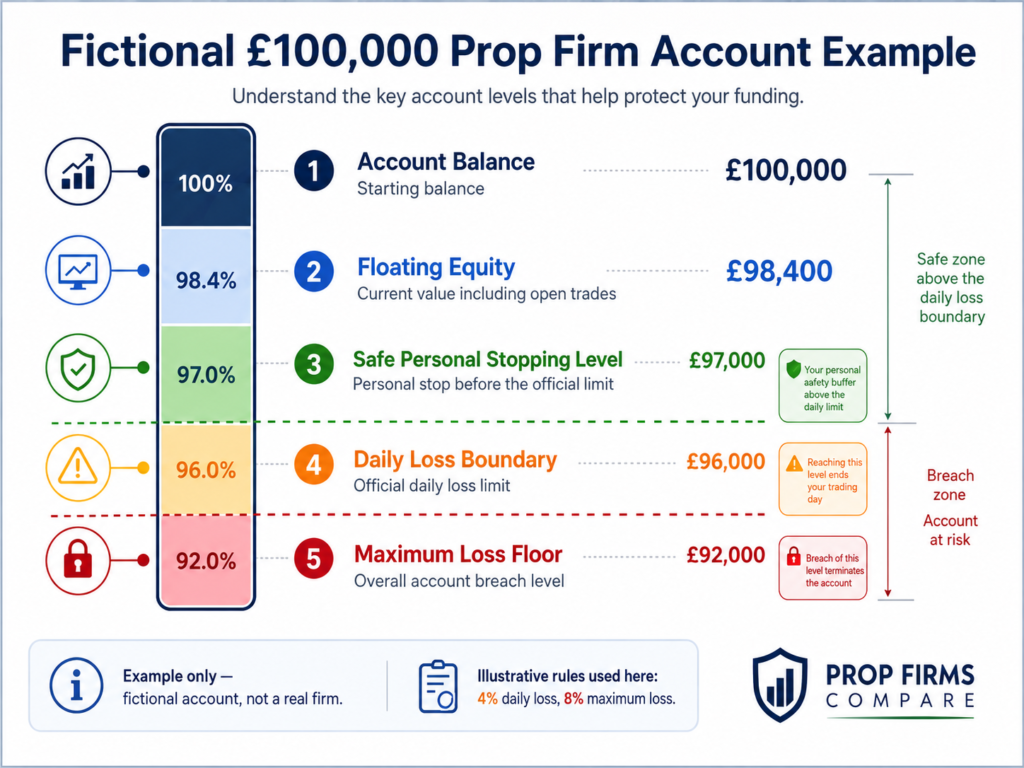
However, the real amount of usable risk is far smaller than the £100,000 headline balance. If the maximum loss is £8,000, that loss allowance is the practical constraint the trader must manage.
Test Your Challenge Plan Before Paying a Fee
Enter your win rate, risk per trade, reward-to-risk ratio and drawdown limits to estimate how often your strategy might pass under simulated trade sequences.
Use the Prop Firm Probability Calculator
What Is a Funded Trading Account?
A funded trading account is the account stage made available after a trader satisfies the firm’s qualification conditions or purchases an instant funding programme.
The word “funded” can be misunderstood. It does not necessarily mean that the full account balance has been transferred to the trader or that the trader owns the money displayed on the platform.
Depending on the firm’s model, the account may be:
- a simulated account with performance-based payouts;
- a live brokerage account using company capital;
- a simulated account whose trades may be copied or hedged elsewhere;
- or part of another risk-management arrangement.
The programme agreement should explain the trader’s legal relationship with the firm and how eligible profits are calculated.
For a beginner, the most important point is that the displayed balance is usually a trading limit or notional account value, not cash that can be withdrawn.
Prop Firm Rules Beginners Must Understand
Most failed accounts are not caused by misunderstanding the profit target. They are caused by misunderstanding or breaching the risk rules.
Daily loss limit
The daily loss limit controls how much an account may lose during a defined trading day.
Check:
- which time zone controls the daily reset;
- whether open losses are included;
- whether commissions and swaps count;
- and whether previous profits affect the calculation.
Maximum overall drawdown
Maximum drawdown is the total loss the account may experience before it is breached.
The limit may be calculated from:
- the original account balance;
- the highest closed balance;
- the highest account equity;
- or an end-of-day account value.
Use the trading drawdown calculator to see how account losses and recovery percentages work.
Static versus trailing drawdown
A static loss floor generally stays in the same position. If the account grows, the trader can create more space above it.
A trailing drawdown can move upwards as the account reaches new highs. Some methods trail continuously, while others update at the end of the trading day.
Balance versus equity
Balance represents closed trading results. Equity includes the current value of open positions.
If the firm uses equity-based limits, a floating loss can breach the account before the trade is closed.
Consistency rules
A consistency rule may limit how much of the account’s profit can come from one trade or one trading day.
A trader could reach the overall target but still fail a consistency requirement if one unusually large result accounts for too much of the total.
News trading rules
Some firms restrict opening, closing or holding trades around specified economic announcements. Others allow news trading but apply different rules during evaluation and funded stages.
Overnight and weekend holding
Swing traders should confirm whether positions can remain open overnight or across the weekend.
Our prop firms for swing traders comparison focuses on this type of account suitability.
Prohibited strategies
Restrictions can apply to latency arbitrage, account sharing, coordinated trading, certain expert advisers, trade copying or strategies that exploit platform errors.
Read the programme terms rather than assuming that a technique permitted by one firm will be accepted by another.
How Prop Firm Fees, Profit Splits and Payouts Work
Challenge or evaluation fee
The evaluation fee purchases access to the challenge. It is normally paid before trading begins.
Some firms refund or credit the fee after a qualifying payout, while others do not. Check the applicable conditions rather than assuming the fee is refundable.
Activation or funded-account fee
Some programmes charge another fee after the trader passes. This may be described as an activation, setup or funded-account charge.
Recurring fees
Certain programmes use monthly subscriptions instead of, or in addition to, an upfront fee. Recurring charges can continue while the trader remains in the evaluation.
Profit split
The profit split determines what portion of an approved payout is paid to the trader and what portion remains with the firm.
A high advertised split should not be considered in isolation. A less restrictive account with a lower split may be more suitable than a high-split account with difficult payout conditions.
Payout schedule
Firms can use weekly, fortnightly, monthly or milestone-based payout schedules. There may also be a minimum number of profitable trading days or a waiting period before the first request.
Other trading costs
Account performance can also be affected by:
- spreads;
- commissions;
- swap or overnight charges;
- data fees;
- platform fees;
- currency conversion;
- and withdrawal costs.
When comparing prices, calculate the likely total cost rather than only the promotional challenge fee.
Our cheap prop firm comparison looks at lower-cost programmes while considering more than the headline price.
How Do Prop Firms Make Money?
The answer depends on the type of firm.
A traditional proprietary trading company primarily aims to earn money from its trading operations.
An online retail evaluation firm may generate revenue from several sources, including:
- challenge and account fees;
- subscription or activation charges;
- a share of trading profits;
- trades copied or executed through live risk-management systems;
- and commercial arrangements with trading platforms or service providers.
The exact business model is not always the same from one company to another.
A beginner should therefore look for clear terms explaining:
- the legal company behind the programme;
- the trader’s contractual status;
- how payouts are calculated;
- which entity receives the fee;
- and how disputes or complaints are handled.
Is a Prop Firm the Same as a Forex Broker?
No. A broker provides access to financial markets and normally handles order execution, pricing, margin and trading accounts.
A retail prop firm provides an evaluation or funded-trader programme. It may work with one or more brokers, liquidity providers or platform companies, but the prop firm itself is not automatically the trader’s broker.
| Question | Forex or CFD broker | Retail prop firm |
|---|---|---|
| Does the trader deposit personal trading capital? | Usually yes | Usually pays a programme fee instead |
| Who defines the challenge rules? | No challenge is normally required | The prop firm |
| Does the trader keep all net profit? | Normally, subject to account costs | No; an agreed split or payout policy applies |
| Can the account be breached? | Losses reduce the trader’s own balance | Breaking a rule can close the programme account |
| Is the account necessarily live? | Normally linked to market execution | Not necessarily; it may be simulated |
Do not assume that a prop firm has the same regulatory permissions or consumer protections as a broker. Check the legal entity and verify any regulatory claims independently.
Benefits and Risks of Trading With a Prop Firm
Potential advantages
- Access to a larger notional account than a trader might fund personally
- Clearly defined account-risk limits
- Potential performance-based payouts
- Reduced need to place a large amount of personal capital into a broker account
- A structured test of trading discipline
- Access to supported trading platforms and account tools
Potential disadvantages
- Challenge fees can be lost
- Strict rules may not suit the trader’s strategy
- Normal losing streaks can breach an account
- Displayed account size can create unrealistic expectations
- Payout eligibility depends on the firm’s terms
- Programme rules and providers can change
- Trading pressure can encourage poor decisions
Read our complete prop trading pros and cons guide before deciding whether the model fits you.
Are Prop Firms Suitable for Beginners?
A beginner can purchase a prop firm challenge, but that does not mean they are ready to pass or remain funded.
A challenge is usually a poor place to learn basic execution, position sizing or emotional control. The fee and strict loss limits can add pressure while the trader is still developing a strategy.
You may be ready to consider a challenge when:
- you have a written trading plan;
- you understand position sizing and pip value;
- you consistently use a stop loss where required by your plan;
- you have tested the strategy over a meaningful sample;
- you know your historical win rate and average reward-to-risk ratio;
- you understand your normal losing streaks;
- you can follow a daily stopping rule;
- and you have read the complete programme terms.
You are probably not ready when:
- you are still changing strategy every week;
- you need to pass quickly to cover personal expenses;
- you do not know how much each trade risks;
- you increase lot size after a loss;
- you are relying on signals you do not understand;
- or you cannot afford to lose the challenge fee.
Beginner Next Step
Review firms selected for clearer account structures and beginner suitability, then verify every rule directly before purchasing.
Compare Prop Firms for Beginners
How to Choose a Prop Firm
Choosing a prop firm should begin with your trading strategy, not a discount code.
1. Match the rules to your trading style
A day trader, scalper and swing trader may need very different conditions. Check holding rules, news restrictions, platform execution and allowed markets.
2. Understand the drawdown calculation
Identify whether the loss limit is static or trailing and whether it uses balance, equity or end-of-day values.
3. Compare the total cost
Include the evaluation fee, activation fee, recurring charges, commissions, data fees and any payout costs.
4. Read the funded-stage rules
Do not stop at the evaluation conditions. Confirm whether the drawdown, consistency requirements or trading restrictions change after passing.
5. Check payout conditions
Review the first payout date, minimum profitable days, profit split, minimum withdrawal and any consistency requirements.
6. Check platform and market availability
Confirm that the firm supports your preferred platform, instruments and trading style.
7. Research the legal company
Check the company name, location, published terms, support contact and history. Verify regulatory claims using the regulator’s own register where relevant.
8. Read independent reviews critically
Look for recurring patterns involving payouts, support, platform stability and unclear rules. Do not rely on one positive or negative review.
9. Test support before purchasing
Send a specific question about a rule. The quality and clarity of the response can help you assess how disputes may be handled later.
10. Start with manageable exposure
Do not buy the largest or most expensive account simply because the headline profit looks more attractive.
Research Before You Purchase
Compare Prop Firm Rules Read Prop Firm Reviews
Prop Firm Warning Signs to Look For
No single signal proves that a firm is unreliable, but several warning signs together should lead to additional research.
- No clear legal company information
- Terms that are difficult to locate or understand
- Unclear drawdown calculations
- Guaranteed-income or easy-money claims
- Pressure to purchase immediately
- Support that avoids answering rule questions
- Frequent unexplained changes to programme conditions
- Large numbers of similar payout complaints
- Regulatory claims that cannot be verified
- Rules allowing the firm to reject payouts without clear criteria
A large social media following, expensive website or high advertised account size does not replace proper due diligence.
How to Start With Prop Firms
- Develop and test a trading strategy. Record enough trades to understand its win rate, average reward and losing streaks.
- Create personal risk rules. Set risk per trade, maximum daily loss and a stopping rule below the firm’s official limits.
- Shortlist suitable firms. Compare programmes based on your strategy and location.
- Read every applicable rule. Include both evaluation and funded-stage conditions.
- Test the plan. Use a demo account or simulation before paying for a challenge.
- Choose an affordable account. Treat the fee as money that could be lost.
- Follow the same process during the evaluation. Do not suddenly increase risk to reach the target faster.
For a more detailed roadmap, read how to start trading with prop firms.
Once you are preparing for an evaluation, continue to our guide explaining how to pass a prop firm challenge.
Your Next Steps
Still learning?
Browse the main education hub for challenge, risk-management and funded-account guides.Browse Prop Firm Guides
Planning a challenge?
Test how your trading statistics could perform against a profit target and drawdown limit.Calculate Your Pass Probability
Choosing a firm?
Compare programmes and account conditions side by side.Compare Prop Firms
Researching a provider?
Read detailed reviews covering account rules, programmes, platforms and potential drawbacks.Browse Prop Firm Reviews
What Is a Prop Firm? FAQs
A prop firm is a proprietary trading company that evaluates or allocates traders under defined risk rules and may share eligible trading profits with traders who meet its conditions.
Prop firm is short for proprietary trading firm. Proprietary trading refers to trading performed for a firm’s benefit rather than executing investments on behalf of clients.
In the retail funded-trader model, a trader usually pays for an evaluation, attempts to meet a profit target without breaching loss limits and may then qualify for a funded-stage account and performance-based payouts.
A prop firm challenge is an evaluation in which a trader must satisfy a profit objective and other conditions while remaining within daily and overall loss limits.
Not always. Some firms place traders on live accounts, while others use simulated accounts and pay traders according to their programme agreements. The displayed account balance should not be assumed to be cash owned by the trader.
Traditional firms aim to earn from trading profits. Retail evaluation firms may earn through challenge fees, subscriptions, activation charges, profit sharing and other commercial or risk-management arrangements.
Most online retail prop firm traders are not salaried employees. They normally receive a share of eligible profits under the programme agreement. Traditional firms can use employment, contractor or partnership arrangements.
Beginners can purchase challenges, but they should first understand position sizing, drawdown, stop-loss risk and their strategy statistics. An evaluation is generally not the best place to learn basic trading skills.
Some firms operate established funded-trader programmes, while others may have unclear terms, poor support or unreliable payout practices. Research the legal company, rules, reputation and payout process before paying a fee.
A prop firm is not automatically regulated in the same way as a broker or investment company. Regulatory status depends on the entity’s activities and jurisdiction. Verify any regulatory claim directly with the named regulator.
The evaluation normally ends when a trader breaks a rule or fails to satisfy the applicable conditions. The fee may be lost, although some firms offer paid resets or new attempts.
The price varies by firm, account size and programme. Check for evaluation, activation, subscription, platform and data costs rather than comparing only the headline fee.
A broker provides market access and order execution. A retail prop firm provides a trading evaluation or funded-account programme and may use a broker or platform provider behind the scenes.
No. The displayed account value is generally not a cash balance owned by the trader. Traders can normally request only eligible profits under the firm’s payout rules.
The most suitable firm depends on the trader’s strategy, location, platform, holding period and risk tolerance. Beginners should prioritise clear rules and suitable drawdown conditions rather than the largest account or highest advertised profit split.
Editorial note: Prop firm programmes can change their prices, rules, platforms and payout conditions. Confirm current terms directly with the relevant firm before purchasing an evaluation.
Last reviewed: June 2026. Published by Prop Firms Compare. This guide is provided for educational and research purposes and does not constitute financial advice. Trading leveraged products involves a risk of loss.
Some links on this page are affiliate links. Prop Firms Compare may receive a commission if you purchase through them, at no additional cost to you. Commercial relationships do not change the criteria used in our reviews and comparisons.