

✅ Researched, compared and ranked
Best Prop Firms with no consistency rule in 2026
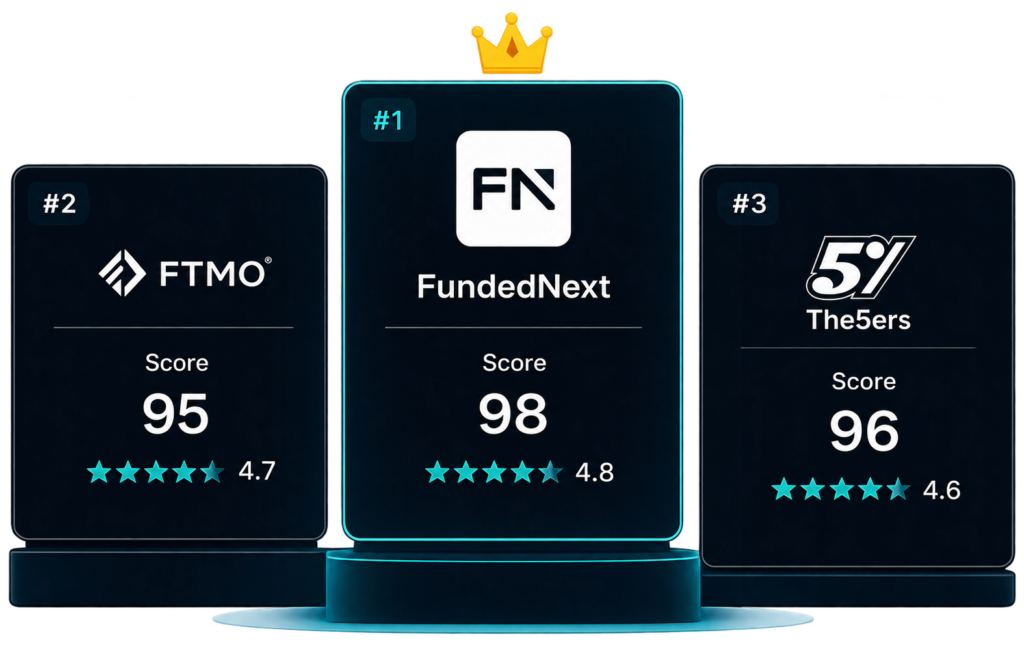
We compared the programmes in our prop firm database and selected five options where the absence of a consistency rule is clearly defined. Our current shortlist includes FundedNext Stellar Instant, FTMO 2-Step, The5ers CFD programmes, FXIFY Two Phase Pro and For Traders Instant PRO.


Christian Preciado
Founder & Lead Researcher at PropFirmsCompare
Christian is the co‑founder and lead researcher at PropFirmsCompare, specialising in prop firm evaluations, trading rules, and payout reliability. With hands‑on experience at Glencore in institutional commodity trading, he brings real‑market insight to every review. He has personally tested dozens of prop firms, focusing on transparency, trader‑first policies, and long‑term funding success
View full bio →
Last verified: 17 September 2026
Methodology: How we compare and score prop firms
Affiliate disclosure: We may earn a commission if you purchase through links on this page, at no extra cost to you. This does not change the rules we report or our editorial scores.
Best prop firms with no consistency rule compared

FundedNext

FTMO

The5ers

For Traders
| Prop firm | Qualifying programme | Evaluation consistency rule | Funded / payout consistency rule | Important alternative condition | Best suited to |
|---|---|---|---|---|---|
| FundedNext | Stellar Instant | No evaluation | None | 6% trailing maximum loss and payout-growth conditions | Traders wanting instant funding without a Best Day rule |
| FTMO | 2-Step | None | None | Four minimum trading days in each evaluation phase | Traders wanting an established two-stage evaluation |
| The5ers | CFD programmes | No percentage-based rule | No percentage-based rule | Programme-specific profitable-day requirements can apply | Traders avoiding a percentage Best Day cap |
| FXIFY | Two Phase Pro | None | None | $4,000 funded daily-profit cap and minimum trading days | Traders wanting static drawdown with no consistency percentage |
| For Traders | Instant PRO | No evaluation | None | 3% payout buffer and 6% trailing maximum drawdown | Traders wanting a simple instant-funded rule set |
A prop firm can remove its consistency rule from one challenge while applying a Best Day rule, minimum profitable-day requirement or payout restriction to another. Some firms also let you pass an evaluation without a consistency rule but introduce one once you reach the funded stage.
The key distinction is programme-level eligibility. For example, FTMO’s 2-Step programme has no Best Day requirement, while FTMO 1-Step currently uses a 50% Best Day rule. Choosing a firm from a generic “no consistency” list without checking the programme can therefore lead to a completely different rule set from the one you expected.
What is a prop firm consistency rule?
A consistency rule controls how concentrated your profits can be.
A common version measures your highest-profit day against the total profit used for a payout:
Best Day ÷ Total Profit × 100 = Consistency Percentage
Suppose your best trading day makes $1,200 and your funded account uses a 30% consistency rule.
To bring that day down to 30% of total profit, you would need:
$1,200 ÷ 0.30 = $4,000 total profit
If your account currently has $2,500 profit, you may be profitable and still be unable to request your payout. You would need to continue trading until your total qualifying profit reached the required level.
That additional trading creates an important problem: you may have already achieved the result you wanted but now need to take more market risk simply to satisfy a payout formula.
For traders whose edge comes from occasional high-conviction trades, breakouts, swing positions or volatile sessions, a no-consistency programme can therefore be materially easier to manage.
It does not, however, mean the account has no trading restrictions.
“No consistency rule” does not always mean the same thing
This is where many comparison pages oversimplify the subject.
There are at least three different situations that traders regularly encounter.
A programme can have no percentage-based consistency rule at either stage, meaning one large profitable day does not need to be diluted simply because it represents too much of total profit.
A programme can have no consistency rule during evaluation but introduce one for payouts. In that case, passing the challenge and withdrawing profits are governed by different rules.
A programme can have no formal consistency percentage but still impose requirements that affect concentrated profits, such as minimum profitable days, payout buffers or daily-profit caps.
We therefore do not classify an entire prop firm as consistency-free simply because one of its programmes qualifies.
1. FundedNext Stellar Instant — strong instant-funding option without a consistency rule

FundedNext’s Stellar Instant programme explicitly states that it has no consistency rule. There is no requirement to match lot sizes, trade frequency or daily performance patterns.
Because Stellar Instant has no evaluation stage, the issue is also simpler than with a traditional one- or two-step challenge: there is no evaluation consistency rule that can later change when you move to a funded-stage account.
There is also no minimum trading-day requirement.
The main restriction to understand is instead the drawdown. Stellar Instant currently has no separate daily loss limit, but it uses a 6% trailing maximum loss. The loss floor rises as realised balance increases and does not subsequently move back down.
Payout eligibility also remains separate from consistency. FundedNext currently provides an on-demand route once the required growth threshold is reached and an alternative 14-day route subject to its published growth conditions.
Why we included FundedNext
Stellar Instant is one of the clearest examples of a programme where “no consistency rule” is explicitly documented rather than inferred from a marketing table.
The downside
A trailing maximum-loss rule can be more important to your strategy than the absence of consistency. A trader who regularly gives back open or realised profit needs to understand exactly how the trailing threshold moves.
FundedNext also offers other programmes with different payout mechanics. Do not assume every FundedNext account has identical consistency conditions simply because Stellar Instant does.
- Best for: experienced traders who want to skip an evaluation and whose returns can be uneven from day to day.
- Less suitable for: traders who prefer a large static drawdown cushion or who are uncomfortable managing a trailing loss floor.
You can also read our fundednext review or compare FundedNext directly against other firms in the comparison tool.
2. FTMO 2-Step — no Best Day rule on the classic two-step route

FTMO is a particularly important example of why programme-level comparisons matter.
The current FTMO Challenge: 2-Step has no Best Day rule. FTMO’s own comparison table shows a dash for Best Day on 2-Step while the newer FTMO 1-Step carries a 50% Best Day rule.
The 2-Step route currently uses a 10% Phase 1 profit target followed by 5% in Verification, with a 5% Maximum Daily Loss and 10% static Maximum Loss.
There are four minimum trading days in each evaluation phase, but there is no minimum trading-day requirement on the subsequent FTMO Account.
Why we included FTMO
The 2-Step programme gives traders a traditional evaluation structure without requiring profitable days to be evenly distributed according to a Best Day percentage.
It is also a useful illustration of why this page names the programme rather than simply placing “FTMO” in a Yes/No table.
The downside
FTMO 1-Step does not qualify for the same description. Its Best Day cannot represent more than 50% of Positive Days’ Profit when passing the challenge or becoming eligible for a reward.
If avoiding consistency is one of your primary buying criteria, choose between the two FTMO structures carefully.
- Best for: traders who prefer a conventional two-phase evaluation, static maximum drawdown and no funded Best Day requirement.
- Less suitable for: traders specifically seeking a one-step challenge without a consistency condition.
See our FTMO review for the wider FTMO rule set.
3. The5ers — no percentage-based consistency rule on CFD programmes
The5ers states that its CFD programmes do not use a percentage-based consistency rule.
That means traders are not generally required to keep their highest-profit day below a fixed percentage such as 30%, 40% or 50% of total profit.
However, this is another case where “no consistency rule” should not be interpreted as “no performance-distribution conditions”.
For example, High Stakes requires at least three profitable trading days, with each qualifying day closing at least 0.5% above the starting balance.
That requirement is different from a Best Day percentage. One exceptional trading day does not automatically force your total profit to increase to a mathematical multiple of that day, but you still need enough qualifying sessions to satisfy the programme conditions.
The distinction matters.
The5ers’ futures programmes should also not be grouped into the same category: current futures rules use a 40% consistency requirement.
Why we included The5ers
The5ers is a useful choice for traders whose main concern is avoiding the classic percentage-based Best Day formula, particularly within its CFD product range.
The downside
Programme-specific minimum profitable-day requirements can still influence how quickly you complete an evaluation or become eligible under the applicable programme rules.
Always check the exact CFD programme rather than treating every The5ers product — including futures — as identical.
- Best for: CFD traders who specifically dislike percentage-based profit-distribution rules.
- Less suitable for: traders who interpret “no consistency” as meaning there can be no minimum profitable-day requirement at all.
Our complete The5ers review covers its programmes in more detail.
4. FXIFY Two Phase Pro — no consistency rule with static drawdown
FXIFY’s Two Phase Pro is one of the cleanest conventional evaluation programmes in this comparison.
FXIFY states that there is no consistency rule during either evaluation step or on the funded account.
The programme also uses an 8% static maximum drawdown, rather than a loss floor that trails upwards as the account grows.
There is, however, an important rule that should not be hidden behind the “no consistency” label: once funded, FXIFY applies a $4,000 daily-profit cap. Reaching the cap moves the account into read-only mode for the rest of that trading day.
That is not a traditional consistency formula because your payout is not calculated by dividing your highest day by total profit. Nevertheless, it can affect a trader whose strategy occasionally produces unusually large single-day gains.
FXIFY also requires qualifying trading days within the programme and offers withdrawals on a 10-day cycle once funded, subject to its current conditions.
Why we included FXIFY
Two Phase Pro combines three characteristics that are particularly easy to model from a risk-management perspective: no percentage consistency rule, static maximum drawdown and defined evaluation targets.
The downside
The daily-profit cap means “no consistency” still does not equal unlimited single-day trading. Traders using large accounts or highly volatile strategies should calculate whether the cap could realistically affect their normal performance.
- Best for: traders who prioritise a static loss floor and want to avoid a percentage Best Day calculation.
- Less suitable for: strategies capable of producing very large individual trading days where the $4,000 funded cap becomes restrictive.
5. For Traders Instant PRO — no consistency or minimum profitable days

For Traders Instant PRO removes several of the conditions traders commonly associate with funded accounts.
There is no evaluation, no daily drawdown limit, no profit target, no minimum trading days, no minimum profitable days and no consistency rule.
Instead, the principal risk restriction is a 6% trailing maximum drawdown based on the highest balance reached.
Withdrawals are available on a bi-weekly cycle, but there is a 3% payout buffer above the starting balance. Only profit beyond that buffer can be withdrawn while the required buffer remains intact.
The profit split currently begins at 60% and increases following successful rewards up to 90%. A maximum single requested performance reward also applies to each reward cycle.
Why we included For Traders
Instant PRO is an especially clean fit for someone whose priority is removing both a percentage consistency rule and minimum profitable-day requirements.
The downside
The starting profit split is lower than many conventional evaluation-funded accounts, and the payout buffer means some account profit needs to remain in place rather than being immediately withdrawable.
Its trailing drawdown also requires careful management after the account reaches new balance highs.
- Best for: experienced traders looking for an instant account with very few profit-distribution conditions.
- Less suitable for: traders prioritising a high starting profit split or a static drawdown model.
Which no-consistency programme should you choose?
There is no reason to choose a programme solely because it says “no consistency rule”.
The better question is what replaces the consistency rule.
| Your priority | Programme to examine |
|---|---|
| Instant access with no consistency or minimum trading days | FundedNext Stellar Instant |
| Established traditional two-stage evaluation | FTMO 2-Step |
| Avoiding percentage-based consistency on CFD programmes | The5ers |
| Static maximum drawdown plus no percentage consistency | FXIFY Two Phase Pro |
| Instant funding with no consistency or profitable-day minimum | For Traders Instant PRO |
Use our comparison tool to compare the current programme rules side by side before deciding.
Five restrictions to check even when there is no consistency rule
“No consistency rule” removes one constraint. It does not remove the need to understand the rest of the account.
Drawdown can matter more than consistency. A tight trailing drawdown can reduce your effective risk budget even when there is complete freedom over how profits are distributed.
Minimum profitable days can produce a similar behavioural constraint. You may not need to dilute a large winning day, but you may still need additional profitable sessions before progressing or receiving a payout.
Payout buffers can leave part of your profit unavailable. For example, a programme may require the account to remain a certain percentage above its starting balance before excess profit becomes withdrawable.
Daily-profit caps can restrict exceptional sessions without technically being a consistency percentage. This is why we show these conditions separately rather than marking every programme simply Yes or No.
News, weekend and strategy rules still apply. A no-consistency account can still restrict high-impact news trading, EAs, copy trading, prohibited strategies or account access.
If you trade longer-term positions, see our best prop firms for swing traders comparison. If instant access matters more than evaluation structure, compare instant funding best prop firms.
No consistency rule vs minimum profitable days
These terms should not be treated as interchangeable.
A consistency rule normally evaluates the concentration of your profits. If your best day is too large relative to total profit, you must typically generate more profit before satisfying the rule.
A minimum profitable-day requirement asks you to record a specified number of qualifying sessions. Your largest day does not necessarily change the amount of total profit you need, but you cannot complete the requirement entirely through a single session.
For a swing trader or event-driven strategy, either restriction can matter — but for different reasons.
This is why our comparison identifies both.
Who benefits most from a no-consistency-rule prop firm?
These programmes are particularly relevant to traders whose profit distribution naturally varies.
A trader may take only a handful of high-quality setups each month. A swing trade can generate a large portion of monthly profit when a multi-day trend finally closes. A breakout strategy may spend days doing very little before one strong session produces most of its return.
In these situations, forcing every profitable period to fit a narrow Best Day percentage can make payout eligibility poorly aligned with the strategy.
Removing the rule does not make the strategy safer or the account easier to keep. It simply removes the requirement to manufacture additional profit because one successful day was “too successful” relative to the others.
How we selected these prop firms
We reviewed the rule data at programme level, rather than treating every product offered by a firm as interchangeable.
A qualifying programme needed current evidence that the conventional percentage-based consistency or Best Day requirement was absent at the relevant stage. We then checked for conditions that could change the practical result, including funded-stage rules, minimum profitable days, payout buffers, daily-profit restrictions and drawdown structure.
That process is why this page can include FTMO 2-Step while explicitly excluding FTMO 1-Step from the same classification.
Rules can change quickly. The verification date on this page matters more than the year in the title, and traders should always check the firm’s current programme documentation before purchasing.

100% Independent & Unbiased Rankings
We test, compare and rank prop firms based on real data and actual trader experiences.
Final verdict
The best no-consistency programme depends on what you are trying to remove from your trading process.
- FundedNext Stellar Instant offers a particularly straightforward instant route with no consistency rule or minimum trading-day requirement, but its trailing loss model still demands careful risk management.
- FTMO 2-Step is a strong alternative for traders who want a traditional two-stage evaluation without the 50% Best Day requirement found on FTMO 1-Step.
- The5ers removes percentage-based consistency from its CFD programmes, although programme-specific profitable-day conditions still need to be checked.
- FXIFY Two Phase Pro combines no consistency with static maximum drawdown, while its daily-profit cap remains an important funded-stage restriction.
- For Traders Instant PRO removes both the consistency rule and profitable-day minimums, but trades that simplicity for a payout buffer, trailing drawdown and lower initial profit share.
The important point is not finding a firm with the words “no consistency rule” on its website. It is finding the exact programme whose complete rule set matches the way you actually trade.
Frequently asked questions
Several prop firms offer at least one programme without a conventional percentage-based consistency rule. Current examples include FundedNext Stellar Instant, FTMO 2-Step, The5ers CFD programmes, FXIFY Two Phase Pro and For Traders Instant PRO. Conditions differ by programme, so a firm should not automatically be considered consistency-free across every account it sells.
It depends on the programme. FTMO 2-Step currently has no Best Day rule. FTMO 1-Step uses a 50% Best Day rule during the challenge and subsequent 1-Step FTMO Account.
FundedNext Stellar Instant explicitly has no consistency rule. Other FundedNext programmes and payout options can use different eligibility conditions, so traders should check the exact account and withdrawal method rather than applying the Stellar Instant rule to the whole firm.
The5ers states that its CFD programmes do not use a percentage-based consistency rule. Some programmes use other requirements, such as minimum profitable trading days. The5ers futures products use separate consistency rules and should not be treated as equivalent to its CFD programmes.
It can be advantageous for traders whose returns are concentrated into occasional strong days because an exceptional session does not need to be diluted purely to satisfy a Best Day percentage. It does not automatically make an account better: drawdown, payout rules, trading restrictions, fees and strategy compatibility still need to be compared.
A 30% consistency rule normally means your highest-profit day cannot represent more than 30% of the total qualifying profit. If your best day earns $1,500, total profit would need to reach at least $5,000 for that day to represent 30%.
Possibly, but only if the programme also has no minimum trading-day or profitable-day requirement. The absence of a consistency rule does not automatically remove minimum days or other evaluation conditions.
No. A consistency rule usually limits the percentage of total profit generated by the best day or trade. A minimum profitable-day rule instead requires a specified number of qualifying sessions. Both can affect how quickly you pass or withdraw, which is why they should be compared separately.